You've probably never heard of MCP. Unless you work in tech or follow AI closely, there's no reason you would have. It stands for Model Context Protocol, and it sounds like something only a software engineer would care about.
But here's why it matters to you: MCP is the technology that will eventually let an AI assistant book your flights, compare hotel prices, and manage your travel plans for you. Not in a vague "someday" way. The infrastructure is being built right now, the biggest tech companies in the world are backing it, and some platforms (including FareEagle) are already connected to it.
This article explains what MCP is, how it works, why travel is one of the first industries it will change, and what it means for you as someone who books flights and hotels.
First, Let's Talk About How You Book Flights Today
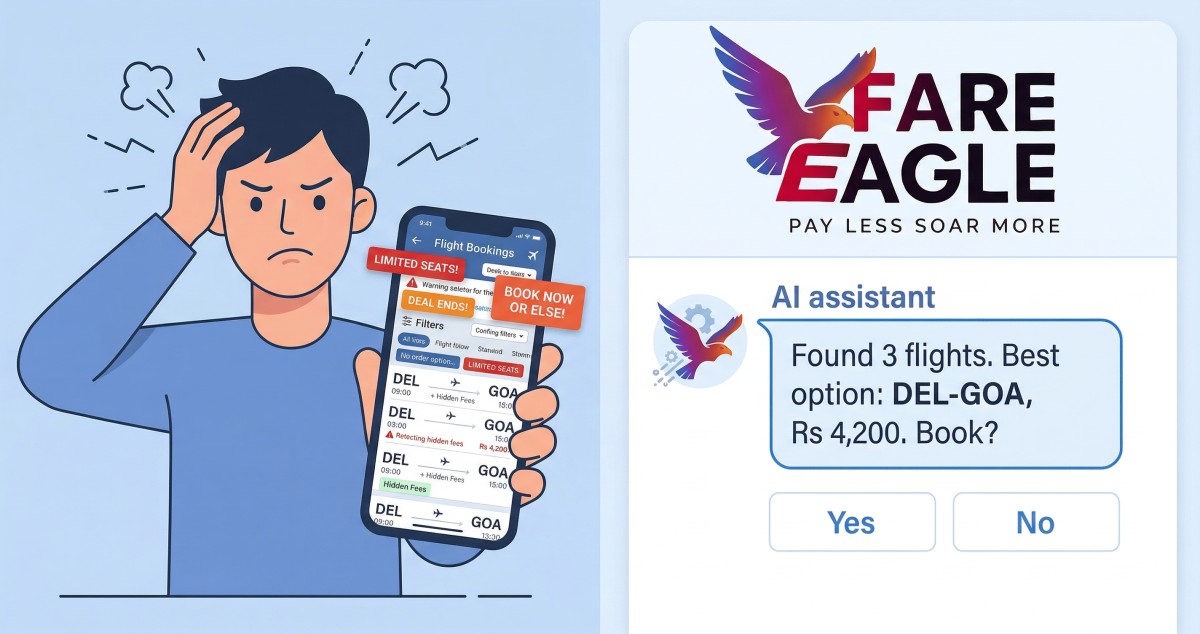
Be honest with yourself about this process. You open a booking app. Type in your departure city and destination. Pick dates. Hit search. Wait for results to load. Scroll through 30, 40, sometimes 50 options. Try to figure out which one is actually cheapest when you factor in baggage (because the base fare doesn't include your check-in bag and the app doesn't make that obvious). Click on one that looks good. Fill in passenger names. Dates of birth. Passport numbers if it's international. Choose seats or get guilted into paying for them. Decline insurance or forget to uncheck the pre-selected box. Decline the "recommended" hotel or car rental. Enter payment details. Confirm. Wait for the confirmation email.
That's 10-15 minutes if everything goes smoothly. More if you're comparing across two or three apps. More if you're booking for a family and need to enter four passengers' details. And more if you've ever closed the app, gone to a competitor, come back, and found that the fare went up by ₹500 while you were gone.
Throughout this entire process, the platform is actively trying to get you to spend more than you planned. Pre-checked insurance. "Only 3 seats left!" urgency messages. Seat selection pop-ups that make you feel like you'll end up in the middle seat of the last row if you don't pay ₹400 extra. Upgrade offers. Add-on bundles. Lounge access upsells.
None of this is accidental. Every element of the checkout flow has been A/B tested thousands of times to maximize how much money the platform extracts from each booking. The user interface is designed for the platform's benefit, not yours.
This is the system that MCP is going to disrupt.
How You'll Book Flights With AI Agents
Now imagine this instead.
You open your AI assistant. Could be Claude, ChatGPT, Gemini, Copilot, or whatever you use. You say something like:
"Find me the cheapest refundable flight from Delhi to Goa next Friday. I need an aisle seat. At least 15kg baggage included in the price. Don't show me options that get in after 10 PM."
The AI agent goes out, searches across multiple travel platforms simultaneously, compares total costs (not just base fares, but total cost with baggage and seat selection included), filters for refundable options only, removes anything arriving after 10 PM, and comes back with 2-3 options. It shows you the airline, timing, total price, and what's included. You pick one. It books it. Done.
No scrolling. No form-filling (the AI already knows your details from previous trips). No dark patterns, because an AI agent can't be tricked by urgency messages or pre-checked boxes. It reads structured data, compares it logically, and presents you with the best options based on what you actually asked for.
The time saving is obvious. The cost saving might be even bigger. An AI agent checking 5 platforms simultaneously and comparing total costs (including hidden baggage fees that platforms bury in the fine print) will almost certainly find a better deal than you scrolling through one app at midnight when you're tired.
So What Is MCP, Exactly?
For the AI assistant to book a flight on your behalf, it needs to be able to talk to the booking platform's systems. It needs to send a search request, receive results, parse the pricing, and eventually submit a booking. This requires a common language that both the AI assistant and the booking platform understand.
That common language is MCP, the Model Context Protocol.
The simplest analogy: think about USB-C. Before USB-C, every device had its own cable. Your phone charger didn't work for your laptop. Your headphones needed a different connector than your camera. USB-C created one standard that handles everything. Plug any USB-C device into any USB-C cable and it works.
MCP does the same thing for AI. It creates one standard protocol that lets any AI assistant connect to any service that supports MCP. A flight booking platform, a hotel search engine, a payment system, a calendar, a CRM, anything. Build the MCP connection once, and it works with Claude, ChatGPT, Gemini, or any AI system that speaks MCP.
MCP was introduced by Anthropic (the company that built Claude AI) in November 2024. Since then, it has been adopted at a speed that's unusual even by tech industry standards:
December 2025: Anthropic donated MCP to the Agentic AI Foundation under the Linux Foundation. OpenAI and Block (the company behind Square and Cash App) joined as co-founders. AWS, Google, Microsoft, Cloudflare, and Bloomberg signed on as supporting members.
By early 2026: Over 97 million monthly SDK downloads. 10,000+ active MCP servers worldwide. First-class support in Claude, ChatGPT, Cursor, Gemini, Microsoft Copilot, and Visual Studio Code.
When Anthropic, OpenAI, and Google all back the same standard, that standard is going to win. MCP is quickly becoming the HTTP of the AI age. And just like HTTP, most people will never need to understand how it works. They'll just benefit from what it enables.
Why Travel Is One of the First Industries This Will Change
Travel booking is one of the ripest industries for AI agent disruption, and there are specific reasons for that.
Travel is already rules-based. Flight prices, baggage allowances, cancellation policies, visa requirements, seat availability. All of this is structured data that AI agents are very good at processing. It's not subjective like "find me a good restaurant." It's quantitative. An AI agent can compare 50 flight options on price, duration, baggage, refundability, and timing in the time it takes you to scroll past three of them.
Travel has a dark pattern problem. The big OTAs have spent years optimizing their interfaces to extract maximum revenue from each visitor. Pre-checked add-ons, urgency messaging, opaque pricing. AI agents are immune to all of this. They read data, not pixels. A pre-checked insurance box doesn't trick an AI because the AI doesn't see the checkbox. It sees a line item that says "₹350 insurance fee" and, unless you asked for insurance, ignores it.
Travel involves comparison shopping. Most people check 2-3 apps when booking an important trip. An AI agent can check 5-10 in seconds. The comparison advantage is massive, especially on international routes where the same itinerary can vary by ₹10,000-20,000 across platforms.
The industry already recognizes this. Business Travel News (one of the most respected travel trade publications) ran a feature in March 2026 calling MCP "the protocol most likely to reshape corporate travel distribution, booking, and payment." Skift, the leading travel industry research firm, has covered MCP extensively. This isn't fringe technology. The industry sees it coming.
FareEagle Is Already MCP-Ready
FareEagle has a live, working MCP server today. Our flight search, hotel search, and booking capabilities are accessible to AI agents right now.
What this means in practice: if you use Claude (Anthropic's AI assistant) and connect FareEagle as an MCP server, you can search flights and hotels through a conversation. You describe what you're looking for in natural language. Claude queries FareEagle's systems, gets real-time results, and presents them to you. No app switching. No form filling. Just a conversation.
We built this early, before most Indian OTAs have even started thinking about it, because we believe the platforms that are machine-readable when AI agents go mainstream will capture traffic. The ones that aren't will become invisible.
It's the same pattern that played out with mobile. In 2012, companies that had mobile-friendly websites won. The ones that said "our desktop site works fine on phones" lost. By 2015, mobile-first was table stakes. The companies that were late spent years catching up.
MCP is the mobile moment for AI. And we'd rather be early than late.
What About Privacy and Control?
This is a fair question and worth addressing directly. If an AI agent is booking flights for you, who controls what happens?
You do. AI agents in the MCP model work on your explicit instructions. They search based on what you ask. They don't spend your money without your approval. The flow is:
1. You tell the AI what you want.
2. The AI searches and presents options.
3. You review the options and approve one.
4. The AI completes the booking (or you do it yourself if you prefer).
It's not autonomous spending. It's assisted booking with full transparency at every step. Think of it like having a very efficient travel secretary who does the research and shows you a shortlist. You still make the final decision.
Privacy-wise, MCP connections work the same way as any other API integration. Your data stays between you, the AI assistant, and the booking platform. FareEagle's MCP server follows the same security and privacy standards as our regular booking systems.
When Will This Become Normal?
It's already happening in pockets. Developers and tech-savvy early adopters are using MCP-connected AI assistants to search and book travel today. Enterprise travel management companies are building MCP integrations for corporate booking tools. Travel industry conferences are running dedicated sessions on agentic booking.
For mainstream consumer adoption, where your parents or in-laws are asking their AI to book a Tirupati trip, we're probably 18-24 months away. The infrastructure is being built now. The AI assistants are getting better at handling multi-step transactions. The trust level is building.
The shift will happen gradually and then all at once. The same way nobody used ride-hailing apps in 2013, and by 2016 everyone's grandmother was booking an Ola. The same way online booking itself went from "nobody trusts it" to "nobody books any other way" in about five years.
The question for travel platforms isn't whether this shift will happen. It's whether they'll be ready when it does.
What This Means for Indian Travellers
India's online travel market is worth over ₹2 lakh crore ($25+ billion). Over 65% of bookings happen on mobile. The market is massive, digitally savvy, and price-sensitive. All three of those characteristics make it ideal for AI agent-driven booking.
Price-sensitive travellers benefit the most from AI comparison shopping. When an agent can check FareEagle, Google Flights, and three airline direct sites in 5 seconds and tell you where the total cost (with baggage) is lowest, you save money consistently. Not once, but on every single booking.
Families benefit from the form-filling automation. Entering details for 2 adults and 2 children across passport numbers, dates of birth, meal preferences, and seat selections is a 20-minute ordeal on a phone screen. An AI agent that already knows your family's details can do it in seconds.
First-time international travellers benefit from the AI's knowledge layer. Ask it "what visa do I need for Thailand?" or "can I transit through Frankfurt without a visa?" and get an accurate, current answer without searching through 15 websites. FareEagle's MCP integration means the AI can answer your visa question and then search for flights in the same conversation.
Try It Yourself
If you use Claude (by Anthropic) and want to see what MCP-powered travel search feels like, you can connect FareEagle as an MCP server and start searching flights through a conversation. It's live today. It works. And it's a glimpse of what travel booking will look like for everyone in a couple of years.
If you prefer the traditional way, FareEagle works great for that too. Clean search, transparent pricing, no hidden fees. Whether a human or an AI agent uses our platform, the experience is honest.
MCP is an evolving open standard maintained by the Agentic AI Foundation under the Linux Foundation. Features and capabilities will expand as the protocol matures. FareEagle's MCP integration is live and actively maintained.