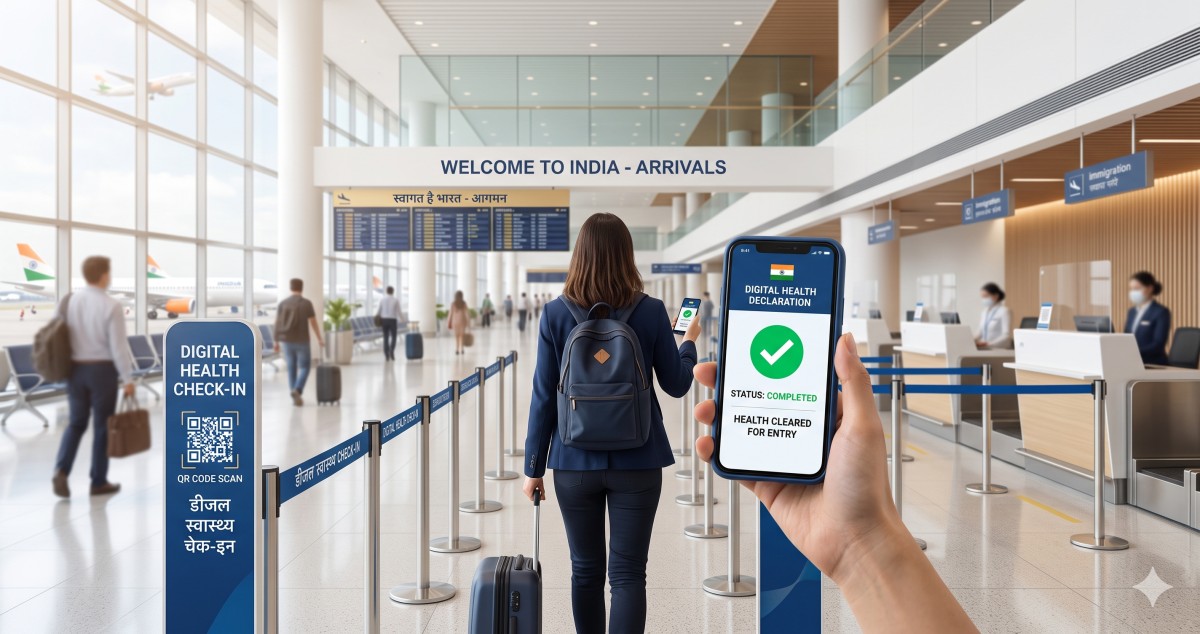
If you are flying into India in the coming weeks, there is a new step to complete before you board. The Government of India has reactivated and upgraded its Air Suvidha portal, and filing the online health self-declaration is now mandatory for every international arrival, regardless of your nationality or where you are flying from.
The Ministry of Civil Aviation and Delhi International Airport Limited (DIAL) launched the upgraded version, Air Suvidha 2.0, on 26 June 2026. Here is the important context first: there is no Ebola outbreak inside India. This is a precautionary border-screening measure, designed to catch and isolate any imported case early while keeping your arrival fast and contactless. Below is everything you need to know to stay compliant and breeze through immigration.
Why This Has Been Brought Back
On 17 May 2026, the World Health Organization declared the Ebola outbreak caused by the Bundibugyo virus in the Democratic Republic of the Congo (DRC) and Uganda a Public Health Emergency of International Concern (PHEIC) under the International Health Regulations (2005). Countries bordering the two nations, including South Sudan, have been assessed by the WHO as high-risk for transmission.
India responded by reactivating the Air Suvidha portal, this time as a dedicated disease surveillance tool. It was originally created in 2020 during the COVID-19 pandemic for digital health declarations. The 2.0 version is built as a broader public health surveillance system that can be switched on for any future health emergency, not just this one.
Who Has to Fill the Form?
This is the part most travellers get wrong, so read carefully. Every international passenger arriving in India must submit the form. There are no exemptions based on where you boarded or your citizenship. That means:
- Returning Indian citizens
- OCI and PIO cardholders
- Foreign tourists and business travellers
- Transit and connecting passengers arriving into India
Even if you have never been anywhere near an Ebola-affected country, you still file the declaration. The single most important field is your 21-day travel history, where you tick any affected country you visited or transited (DR Congo, Uganda, or South Sudan), or simply select "None of the above." The reason the window is 21 days is medical: Ebola has an incubation period of up to 21 days, so authorities use your recent travel history to decide whether anyone needs closer monitoring.
How to Complete Air Suvidha 2.0: The 4 Steps
The whole process is online and takes only a few minutes. You can complete it up to 24 hours before arrival. The best time to do it is during web check-in or before you board.
| Step | What You Enter |
|---|---|
| 1. Personal & Flight Details | Full name (exactly as per passport), gender, age, nationality, passport number |
| 2. Contact & OTP | Mobile number and email, verified via a one-time password |
| 3. Health Declaration | Your 21-day travel history, any exposure, and any symptoms |
| 4. Verify & Submit | Review your details, submit, and download the form |
Once submitted, download the Self-Declaration Form (SDF) and either save it to your phone or print it. On landing, you only need to show the downloaded form at the International Travel Health Desk or the Immigration counter. There are no physical forms to fill on the aircraft or after you land.
The official portal is at airsuvidha.civilaviation.gov.in. Only use the official government site and avoid any third-party page that asks for a fee, as the form itself is free.
What Changed From the Old Paper System
The biggest practical win here is speed. Earlier, passengers had to fill out physical health forms onboard, which regularly created long queues and congestion at arrival halls. The 2.0 system is fully contactless and links your declaration in real time to the agencies that need it:
- The Airport Health Officer
- The Bureau of Immigration
- The Integrated Disease Surveillance Programme (IDSP)
- State Surveillance Officers
This real-time data sharing lets authorities quickly identify and refer any at-risk traveller for screening without slowing down everyone else. For the vast majority of passengers who have not been to an affected region, it means a faster, smoother arrival than the old paper process ever allowed.
What Happens If a Case Is Suspected
India has set out clear procedures so you know what to expect. If a passenger shows symptoms during the flight, cabin crew isolate them and the airline notifies the destination airport's health office before landing. On arrival, a dedicated medical team handles the transfer to isolation. Travellers who are asymptomatic but have an exposure risk may be asked to self-monitor, check their temperature daily, and contact health helplines if they develop a fever or rash within the 21-day window. To be clear, this applies to a very small number of people, almost entirely those with recent travel to the affected provinces.
A Quick Note on the Global Situation
For perspective, health agencies including the CDC and the European Centre for Disease Prevention and Control assess the risk to travellers outside the affected region as low to very low. The outbreak is concentrated in the Ituri, North Kivu, and South Kivu provinces of eastern DRC, with a small number of imported cases reported in Uganda and one in France. India's measure is a sensible precaution at the border, not a sign that the virus is circulating here.
Your Pre-Flight Checklist for India
To make sure your arrival goes smoothly, do this before you fly:
- File the form within 24 hours of arrival. Ideally during web check-in or just before boarding.
- Use your passport name exactly. Mismatches can cause hold-ups at the counter.
- Answer the travel-history question honestly. This is a government health declaration, and a false statement can mean trouble at immigration.
- Download and carry the SDF. Save it offline on your phone or print a copy in case of no signal.
- Only use the official portal. airsuvidha.civilaviation.gov.in. The form is free.
- Check before you fly. Health and entry rules can change at short notice, so confirm with your airline or the official portal close to departure.
The Bottom Line
Air Suvidha 2.0 adds one short, free, online step to your journey to India. Fill it in before you board, carry the downloaded form, and you will clear the health desk in seconds. It is a small task that keeps both you and the country safe, and the contactless system is genuinely faster than the paperwork it replaced.
Planning a trip to or from India? We make the flying part simple, with transparent pricing and real-time fares across airlines.
This guide reflects rules announced as of June 2026. Health and entry requirements can change at short notice. Always confirm on the official Air Suvidha portal or with your airline before travelling.