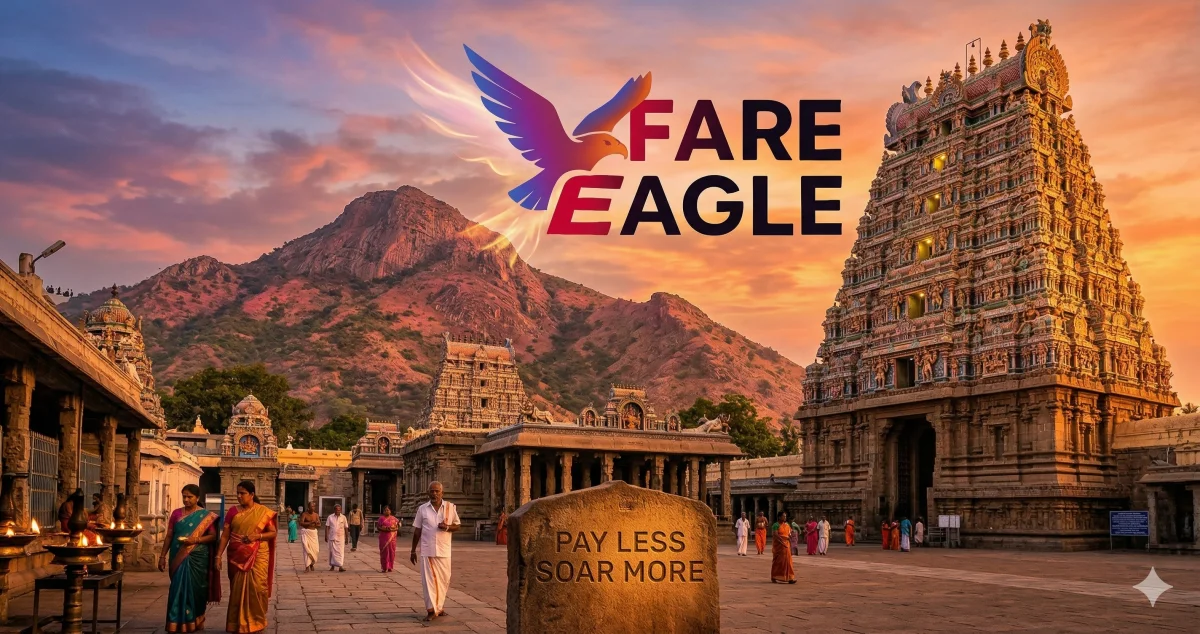
The Arunachaleswarar Temple in Tiruvannamalai is one of the most powerful Shiva temples in India — a place where the element of fire is worshipped, where a 3.5-billion-year-old hill is considered a living form of Lord Shiva, and where over a million devotees walk barefoot around the sacred mountain on full moon nights. This is not a quick darshan stop — it is a spiritual experience that changes people. Whether you’re coming from Chennai for a weekend, flying in from Delhi, or traveling from the United States, this guide covers every detail for your Tiruvannamalai pilgrimage in 2026.
About Arunachaleswarar Temple
The Arunachaleswarar (Annamalaiyar) Temple is one of the five Pancha Bhoota Sthalams — temples representing the five elements of nature. This temple represents Agni (Fire), and Lord Shiva is worshipped here as a massive lingam of fire. The temple complex spans 25 acres, making it one of the largest temples in India, with four towering gopurams (gateway towers). The eastern Rajagopuram rises 66 metres — one of the tallest temple towers in India — and is visible from anywhere in the town.
The sacred Arunachala Hill behind the temple is not just a geographical feature but is worshipped as a form of Shiva himself. Geologically, it is one of the oldest rock formations on Earth at approximately 3.5 billion years old. The Girivalam (circumambulation of the hill, 14 km barefoot walk) is one of the most sacred rituals in Shaivism, performed by lakhs of devotees every Pournami (full moon).
Tiruvannamalai is also the home of Sri Ramana Maharshi, the 20th-century sage who lived on Arunachala Hill for decades. His ashram (Sri Ramanasramam) remains one of the most visited spiritual centres in India.
Temple Timings
The temple follows a fixed daily schedule. (Timings may vary during festivals.)
Morning: 5:30 AM – 12:30 PM
Evening: 3:30 PM – 9:30 PM
Key puja timings: Abhishekam at 6:00 AM (the most powerful daily ritual — the Shiva Lingam is bathed with milk, honey, and sacred water). Evening Deeparadhana (lamp ceremony) at ~7:30 PM. The temple closes briefly between 12:30 PM and 3:30 PM for naivedyam (food offering to the deity).
On Pournami (full moon) nights, the temple stays open late and the Girivalam path is active throughout the night.
Girivalam — Walking Around Arunachala Hill
Girivalam is the 14-km barefoot walk around Arunachala Hill, performed on Pournami (full moon) and other auspicious days. It is considered one of the most spiritually powerful acts a devotee can perform at Tiruvannamalai.
Duration: 3–5 hours at a comfortable pace. Most devotees start after sunset and complete it by midnight or early morning.
Route: The path is a well-paved road that circles the hill, passing through eight lingam shrines (Ashta Lingams) representing the eight directions. The path is well-lit during Pournami with temporary lighting, food stalls, and police presence.
What to carry: Water, comfortable footwear (many walk barefoot), a small towel, cash/UPI for food stalls. Travel light — leave bags at your hotel.
Crowds: Pournami nights draw 5–10 lakh devotees. Arrive early afternoon to settle in, start Girivalam by 6–7 PM. Weekday Girivalam (non-Pournami) is much quieter and equally powerful.
How to Reach Tiruvannamalai from Major Indian Cities
Important: Tiruvannamalai has no airport. The nearest airports are Chennai (MAA, 175 km) and Bengaluru (BLR, 250 km). The town has its own railway station (TNM) with limited services, and excellent bus connectivity from South Indian cities.
By Air (Fly to Chennai or Bengaluru, then road/rail)
Since there’s no airport in Tiruvannamalai, you fly into a nearby city and complete the journey by road or train. (Flight schedules as of March 2026 — verify on FareEagle.)
Via Chennai (MAA) — 175 km, 4–5 hours by road: Chennai is the most practical gateway. Fly into Chennai International Airport from any Indian city or abroad, then take a taxi (₹3,000–5,000) or TNSTC bus from Koyambedu bus stand (₹180–350, buses every 30 min, 3.5–4.5 hours).
| From | Airlines | Flight Time | Fare (one-way) |
|---|---|---|---|
| Delhi → Chennai | IndiGo, Air India, SpiceJet, Vistara — 15+ daily | 2h 40m | ₹3,500–8,000 |
| Mumbai → Chennai | IndiGo, Air India, SpiceJet — 15+ daily | 2h | ₹3,000–7,000 |
| Hyderabad → Chennai | IndiGo, Air India, SpiceJet — 10+ daily | 1h 20m | ₹2,000–5,000 |
| Kolkata → Chennai | IndiGo, Air India — 5+ daily | 2h 30m | ₹3,500–8,000 |
Via Bengaluru (BLR) — 250 km, 4–5 hours by road: Fly into Kempegowda International Airport, then drive via Hosur–Krishnagiri–Tirupattur–Tiruvannamalai. Taxi: ₹4,000–6,000. Direct KSRTC/private buses available from Majestic bus stand (₹400–700, 5–6 hours).
By Train
Tiruvannamalai Railway Station (TNM) is on the Villupuram–Katpadi line. It’s a small station with limited but useful services. The station is 2 km from the temple — autos cost ₹50–80. Book on IRCTC.
Direct trains to Tiruvannamalai (TNM):
From Chennai: Chennai Egmore–Tiruvannamalai trains via Villupuram. Journey: 3–4 hours. Multiple daily services including passenger and express trains.
From Tirupati: Direct train (Train 16853). Journey: ~5 hours. Twice daily.
From Villupuram: Frequent passenger trains, 1.5–2 hours. Villupuram is a major junction on the Chennai–Madurai and Chennai–Trichy lines — useful for connecting from cities across Tamil Nadu.
From Katpadi (Vellore): Direct trains, ~2 hours. Katpadi is a major junction on the Chennai–Bengaluru line — useful for connecting from Bengaluru, North India, and western cities.
Connecting strategy for North India / distant cities: Take any long-distance train to Katpadi Junction (Chennai–Bengaluru line) or Villupuram Junction (Chennai–Trichy line), then connect to a local train or bus to Tiruvannamalai. This works from Delhi, Mumbai, Kolkata, Hyderabad, and any city with a train to Chennai or Bengaluru.
By Road
From Chennai: 175 km via NH38 (Chengalpattu–Tindivanam–Gingee–Tiruvannamalai), 4–5 hours. TNSTC buses every 30 minutes from Koyambedu (₹180–350). Private buses and taxis available.
From Bengaluru: 250 km via Hosur–Krishnagiri–Tirupattur–Chengam, 4–5 hours. KSRTC and private buses (₹400–700).
From Puducherry (Pondicherry): 100 km, 2–2.5 hours. Frequent buses. Popular combo trip.
From Vellore: 85 km, 2 hours. Regular buses.
How to Reach Tiruvannamalai from Abroad
From the United States
Best route: Fly to Chennai (MAA). Air India operates nonstop flights from select US cities to Delhi, then connect to Chennai (2h 40m domestic flight). Or fly via Dubai/Singapore to Chennai directly.
Example (Atlanta): Atlanta → Dubai (Emirates, 14h) → Chennai (Emirates, 4h) → Taxi to Tiruvannamalai (4–5h). Total: ~24 hours travel.
Example (San Francisco): SFO → Bengaluru (Air India nonstop, 17h) → Drive to Tiruvannamalai (4–5h).
From the UK
London Heathrow → Chennai (Air India nonstop, 10h). Then taxi or bus to Tiruvannamalai.
From the Middle East (Dubai, Abu Dhabi, Doha)
Direct flights to Chennai (4h) on Emirates, Air India Express, IndiGo, Air Arabia. Then road to Tiruvannamalai (4–5h). You can reach the temple within 10–12 hours of leaving Dubai.
From Singapore / Malaysia
Fly to Chennai (Singapore Airlines, Scoot, IndiGo — 3.5–4h). Then road/train to Tiruvannamalai.
Karthigai Deepam — The Festival of the Sacred Flame
Karthigai Deepam (November/December) is the most important festival at Tiruvannamalai and one of the most spectacular religious events in South India. A massive flame (Mahadeepam) is lit atop Arunachala Hill — visible for kilometres around — symbolising Lord Shiva’s manifestation as an infinite column of fire. The flame burns for several days, and the entire town is illuminated with millions of oil lamps.
During Deepam week, 10–15 lakh devotees descend on Tiruvannamalai. Book accommodation months in advance. Transport and roads become extremely congested — arrive at least a day before the main Deepam day.
Accommodation
Hotels: Budget hotels near the temple start at ₹500–1,500/night. Mid-range options with AC: ₹1,500–4,000/night. Book early during Pournami weekends and Karthigai Deepam.
Ashrams: Sri Ramanasramam offers free/donation-based accommodation for genuine spiritual seekers (limited rooms, simple facilities). Seshadri Swamigal Ashram and other smaller ashrams also offer basic rooms. These are for contemplative stays, not tourist accommodation.
Trust accommodation: The temple trust operates basic rooms near the temple. Inquire at the temple office.
What to Eat
Tiruvannamalai is a vegetarian town near the temple area. South Indian food dominates: idli, dosa, pongal, thali meals (₹60–150), filter coffee (₹10–30). Restaurants on Car Street and near the bus stand are reliable. During Girivalam nights, temporary food stalls along the 14-km path serve snacks, tender coconut, and light meals.
Places to Visit Near the Temple
Sri Ramanasramam — 2 km from the temple. The ashram of Sri Ramana Maharshi. Meditation hall, Ramana’s samadhi shrine, library, and bookshop. Open to all. Free entry. One of the most peaceful places in Tiruvannamalai.
Virupaksha Cave & Skandashram — On the slopes of Arunachala Hill. Caves where Ramana Maharshi meditated for years. Short hike from the ashram. Stunning views of the town and temple.
Sathanur Dam — 30 km from Tiruvannamalai. A scenic dam across the Thenpennai River. Good for a half-day excursion.
Gingee Fort — 37 km from Tiruvannamalai. Called the “Troy of the East” by the British. A massive 15th-century hilltop fort complex. 2–3 hour visit.
Best Time to Visit
October–February (Winter): Best weather (18–28°C). Karthigai Deepam falls in this period (November/December). Peak pilgrim season.
March–May (Summer): Very hot (35–42°C). Girivalam in summer heat is challenging. Visit early morning or evening only.
June–September (Monsoon): Cooler with rain. Arunachala Hill looks lush and beautiful. Fewer crowds. Good for contemplative visits.
Pournami dates: Check the Tamil calendar for full moon dates — these are the most powerful days for Girivalam. Arrive a day before for the best experience.
Budget Breakdown
| Expense | Budget | Comfortable |
|---|---|---|
| Temple darshan | Free | Free (special puja: ₹50–500) |
| Accommodation (1–2 nights) | ₹500–1,500 | ₹2,000–4,000 |
| Food (1–2 days) | ₹200–400 | ₹400–800 |
| Local transport | ₹100–200 | ₹300–600 |
| Travel from Chennai (road/train) | ₹180–500 | ₹3,000–5,000 (taxi) |
Practical Tips
Dress code: Modest traditional attire. Men: dhoti/formal pants with shirt. Women: saree/salwar kameez. No shorts or sleeveless tops inside the temple.
Girivalam preparation: Wear comfortable footwear (or go barefoot as tradition dictates). Start by 5–6 PM to finish before midnight. Carry water and a light snack. Stay on the main path — do not take shortcuts through unlit areas.
Language: Tamil is the primary language. Hindi and English are limited outside hotels. Google Translate helps. Write your hotel address down in Tamil before arriving.
Festival crowds: During Karthigai Deepam and Pournami, vehicle entry is restricted within 1 km of the temple from 4 PM. Park at designated lots and walk. Arrive early.
Photography: Allowed in the outer corridors and gopurams. Not allowed inside the sanctum sanctorum. Turn off flash and phone sounds.
Combine trips: Tiruvannamalai + Puducherry (100 km, 2 hrs) + Mahabalipuram (180 km, 3.5 hrs) makes a great 4–5 day Tamil Nadu spiritual and cultural circuit.
Frequently Asked Questions
How do I reach Tiruvannamalai without an airport?
Fly to Chennai (175 km) or Bengaluru (250 km), then take a taxi (₹3,000–6,000) or bus (₹180–700) to Tiruvannamalai. The road journey is 4–5 hours from either city. Alternatively, take a train to Tiruvannamalai (TNM) station via Katpadi or Villupuram junctions.
What is Girivalam and when should I do it?
Girivalam is the 14-km barefoot walk around Arunachala Hill, one of the most sacred rituals in Shaivism. It’s most powerful on Pournami (full moon) nights, when lakhs of devotees participate. You can also do it on any day — weekday Girivalam is quieter and equally meaningful.
What is Karthigai Deepam?
The biggest festival at Tiruvannamalai (November/December). A massive sacred flame is lit atop Arunachala Hill, symbolising Shiva as an infinite column of fire. 10–15 lakh devotees attend. Book accommodation months in advance.
Can NRIs and foreigners visit?
Yes. The temple welcomes all visitors. No special permits needed. Many international devotees visit Sri Ramanasramam and participate in Girivalam regularly.
Is Tiruvannamalai vegetarian only?
The temple area and central town are strictly vegetarian. Non-vegetarian restaurants exist on the outskirts but are rare. Expect excellent South Indian vegetarian food.
How many days do I need?
2 days minimum (1 day temple + Girivalam, 1 day Ramanasramam + caves). 3 days ideal if including Gingee Fort or a leisurely Girivalam. For Karthigai Deepam, plan 3–4 days.
Experience the Fire of Arunachala.
Compare flights to Chennai or Bengaluru on FareEagle, then complete your journey to Tiruvannamalai.