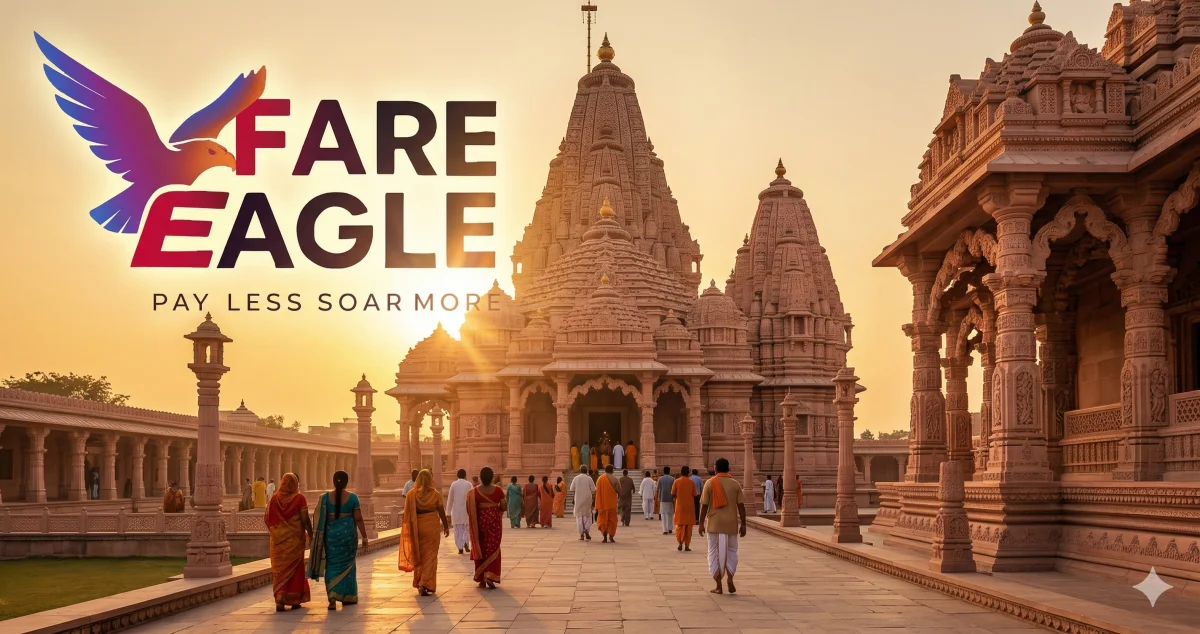
The Ram Mandir in Ayodhya is the realisation of a dream that millions of devotees held for over 500 years. Standing on the Ram Janmabhoomi — the sacred site believed to be the birthplace of Lord Rama — the Shri Ram Janmabhoomi Mandir was consecrated on January 22, 2024, in a historic Pran Pratishtha ceremony. Built entirely in the traditional Nagara style using pink sandstone from Rajasthan and white Makrana marble, with no iron or steel (designed to last over 1,000 years), the temple complex spreads across 70 acres and has already become one of the most visited pilgrimage sites in the world. Whether you’re traveling from Delhi, flying in from Mumbai, or visiting from abroad, this guide covers everything for your 2026 pilgrimage.
About the Ram Mandir
The main sanctum houses the idol of Ram Lalla — the infant form of Lord Rama — enshrined in the garbhagriha (sanctum sanctorum). The temple’s walls and pillars are adorned with intricate carvings depicting scenes from the Ramayana. The complex includes multiple smaller shrines, a museum, a library, a yatri facilitation centre, and landscaped gardens.
The temple measures 360 feet long, 235 feet wide, and 161 feet tall with three floors. The ground floor houses the main Ram Lalla idol; the first floor will feature an older Ram Darbar, and the second floor will hold Vaidik Vangmay displays. The construction used over 600,000 cubic feet of stone and the temple’s 392 pillars and 44 doors are carved with depictions from the Ramayana, Hindu deities, and lotus motifs. The Mandap alone features 160 carved pillars. When fully complete (construction of the outer complex continues in 2026), it will be one of the largest Hindu temples built in modern India.
The temple was built by the Shri Ram Janmabhoomi Teertha Kshetra Trust, established after the Supreme Court of India’s 2019 verdict. The foundation stone was laid by Prime Minister Narendra Modi in August 2020, and construction was completed using traditional stone interlocking techniques with copper plates instead of iron — an engineering approach designed to make the structure endure for millennia without rust.
One of the temple’s most remarkable features is the Surya Tilak — an optical mechanism that directs sunlight onto Ram Lalla’s forehead precisely at noon on Ram Navami, the birthday of Lord Rama. This extraordinary feat of astronomical engineering drew worldwide attention when it was first demonstrated during Ram Navami 2024.
Darshan Timings
General darshan: 7:00 AM – 11:30 AM & 2:00 PM – 7:00 PM (approximate; timings are divided into 2-hour slots and may be updated by the Trust).
Aarti schedule:
4:30 AM: Mangala Aarti (dawn, before darshan opens — requires separate aarti pass)
~11:30 AM: Madhyahna Aarti (midday)
~7:00 PM: Sandhya Aarti (evening — the most emotionally powerful; separate pass required)
~9:00 PM: Shayan Aarti (night)
Average darshan time: 60–75 minutes on normal weekdays. 2–4 hours on weekends. 4–6+ hours during festivals.
Sugam Darshan (Free E-Pass)
The Trust has introduced Sugam Darshan — a free online e-pass system that lets you select a specific date and time slot, significantly reducing queue time. This is the recommended way to visit.
How to book: Visit online.srjbtkshetra.org. Register with your mobile number, select your date and slot, enter devotee details and ID proof, and download the e-pass. Show the e-pass and matching ID at the temple entrance.
Booking window: Slots open 15–30 days in advance. Popular timings (early morning, weekends) fill up within minutes. Book as early as possible. Aarti passes are booked separately through the same portal and are extremely high in demand.
Walk-in darshan: Available without booking, but expect much longer queues, especially on weekends and festivals.
Important rules: No mobile phones, cameras, or electronic devices inside the temple complex. Deposit at lockers outside (or leave at your hotel — faster). Be prepared for a ~1 km walk from the security checkpoint to the sanctum. Private vehicles are restricted in the “Yellow Zone” around the temple — use e-rickshaws from parking areas. Thorough security checks (airport-style) — arrive at least 1 hour before your slot.
How to Reach Ayodhya
By Air
Maharishi Valmiki International Airport (AYJ) is just 8–10 km from the Ram Mandir (20–30 minutes by taxi, ₹200–400). The airport has grown rapidly since the temple’s inauguration and now has direct flights from Delhi, Mumbai, Ahmedabad, Bengaluru, Kolkata, Hyderabad, and several other cities.
Compare fares on FareEagle.
By Train
Ayodhya Dham Junction (AY) is the main railway station, less than 2 km from the Ram Mandir. E-rickshaws and autos are available outside (₹20–50 to the temple area). Book on IRCTC.
From Delhi: Ayodhya Express, Humsafar Express — 10–12 hours. Multiple daily services.
From Lucknow: Multiple trains daily, 2.5–3.5 hours. The most frequent connection. Also excellent road connectivity (135 km, 3 hours).
From Varanasi: Direct trains, 5–6 hours. Many pilgrims combine Ayodhya + Varanasi.
From Mumbai: LTT–Ayodhya Express, 24–28 hours. Or fly to Lucknow/Ayodhya.
From Kolkata: Direct trains, 16–20 hours. Or fly to Ayodhya directly.
Faizabad Junction (Ayodhya Cantt) is an alternative station, 11.5 km from the temple, with additional train connectivity.
By Road
From Lucknow: 135 km via excellent highway, 3 hours. Frequent UP State Roadways and private buses (₹200–500).
From Varanasi: 200 km, 4–5 hours by road.
From Delhi: 630 km via Lucknow, 10–12 hours by car. Overnight Volvo buses available.
From Prayagraj (Allahabad): 160 km, 3–4 hours. Popular pilgrimage combo.
How to Reach from Abroad
From the United States
Fly to Delhi (Air India nonstop from NYC, Chicago, SFO, Washington), then connect to Ayodhya (domestic flight, 1.5h) or take the Ayodhya Express train (10–12h). Alternatively, fly to Lucknow from Delhi, then road to Ayodhya (3h).
Example: New York → Delhi (Air India, 15h) → Ayodhya (IndiGo domestic, 1.5h) → temple (20 min from airport).
From the UK
London → Delhi (nonstop, 8–9h) → Ayodhya (flight 1.5h or train 10h). Or London → Lucknow (connecting) → road to Ayodhya (3h).
From the Middle East
Dubai/Doha → Delhi or Lucknow (3.5–4.5h) → Ayodhya by flight or road.
From Singapore / Southeast Asia
Singapore → Delhi (5.5h) → Ayodhya (1.5h domestic flight).
Ram Navami at Ayodhya
Ram Navami 2026: March 26, 2026 — the birthday of Lord Rama. This is the biggest event of the year at the Ram Mandir.
Surya Tilak: At precisely 12:00 noon, an optical mechanism directs sunlight onto Ram Lalla’s forehead. Millions watch this moment on live television.
Crowd: 20–30 lakh pilgrims. All VIP and Sugam Darshan passes are suspended — everyone uses the general queue. The temple stays open for 19–20 hours on this day.
Planning: Book accommodation months in advance. Many stay in Lucknow (135 km) or Varanasi (200 km) and travel to Ayodhya for the day. Arrive very early morning.
What to See in Ayodhya
Hanuman Garhi: A hilltop temple dedicated to Lord Hanuman, traditionally visited before the Ram Mandir. Climb 76 steps to reach the temple. One of the most popular temples in Ayodhya.
Kanak Bhawan: A beautiful temple dedicated to Lord Rama and Goddess Sita, known for its ornate gold and silver crowns on the deities. Just 500 metres from the Ram Mandir.
Ram Ki Paidi (Ghats): Steps leading down to the Saryu River. During Diwali, thousands of oil lamps (Deepotsav) are lit along these ghats — one of India’s most spectacular Diwali celebrations.
Sita Ki Rasoi: Near the Ram Janmabhoomi complex. The mythological kitchen of Goddess Sita — one of Ayodhya’s most unique and revered sites.
Saryu River: The sacred river of Ayodhya, mentioned extensively in the Ramayana as the river that flowed past the kingdom of Kosala. Evening walks along the ghats are peaceful and beautiful. Many devotees take a holy dip in the Saryu before visiting the Ram Mandir — the river is considered as sacred as the Ganga in this region. Boat rides are available during winter months.
Nageshwar Nath Temple: An ancient Shiva temple believed to have been established by Kush (son of Lord Rama). One of Ayodhya’s oldest surviving temples with significant archaeological importance.
Gulab Bari: A Mughal-era mausoleum with beautiful rose gardens. A peaceful contrast to the temple visits, located in the Faizabad area.
Accommodation
Dharamshalas: Multiple dharamshalas near the temple area, ₹200–800/night. Basic, clean, and close to the temple.
Budget hotels: ₹800–2,000/night near the bus stand and railway station area.
Mid-range to premium: New hotels have opened rapidly since 2024. ₹2,000–8,000/night. Options along the Lucknow highway and near Ram Ki Paidi.
Lucknow fallback: If Ayodhya hotels are full (very common during Ram Navami, Diwali, and weekends), stay in Lucknow (135 km, 3h) and day-trip to Ayodhya.
What to Eat
Ayodhya is a strictly vegetarian city near the temple area. The food is Awadhi-UP style satvik cuisine.
Temple prasadam: Available at designated counters after darshan.
Local food: Kachori-sabzi (Ayodhya’s famous breakfast), puri-aloo, pedha (sweet), lassi, jalebi. Restaurants near Hanuman Garhi and Ram Ki Paidi serve excellent thali meals for ₹80–200.
Best Time to Visit
October–February (Winter): Best weather (8–25°C). Diwali Deepotsav (October/November) at Ram Ki Paidi is spectacular — in 2024, over 28 lakh diyas (oil lamps) were lit along the Saryu ghats, setting a world record. The entire city is illuminated. Peak pilgrim season but absolutely worth the crowds.
Ram Navami (March): The biggest festival. Hot but spiritually the most powerful time. Book everything months ahead.
April–June (Summer): Very hot (38–45°C). Fewer pilgrims. Early morning visits only.
July–September (Monsoon): Rain and humidity. Saryu River may flood. Temple remains open but outdoor sightseeing is limited.
Practical Tips
Book Sugam Darshan online: This is the single most important tip. Book 15–30 days ahead at online.srjbtkshetra.org. It’s free and dramatically reduces your queue time.
Leave electronics at the hotel: No phones/cameras inside. Using the locker outside takes extra time. Travel light — carry only your ID, e-pass printout, and wallet.
Wear comfortable slip-on shoes: You’ll need to remove footwear multiple times. The walk from security to sanctum is ~1 km.
Dress code: Modest traditional Indian attire. No shorts, sleeveless tops, or revealing clothing.
E-rickshaws: The main transport within Ayodhya’s temple zone. Private vehicles are restricted near the temple. Uber has launched e-auto service in Ayodhya.
Combine with Varanasi: Ayodhya (2 days) + Varanasi (2–3 days) + Prayagraj (1 day) makes a powerful 5–6 day Uttar Pradesh spiritual circuit.
ID proof mandatory: Carry a government-issued photo ID (Aadhaar, passport, voter ID) matching your Sugam Darshan booking.
Frequently Asked Questions
Is the Ram Mandir darshan free?
Yes. General darshan and Sugam Darshan are completely free. Aarti passes are also free but must be booked separately online.
Do I need to book online?
Not mandatory, but strongly recommended. Sugam Darshan (free e-pass) reduces your queue time from hours to minutes. Book at online.srjbtkshetra.org 15–30 days in advance.
Can I take my phone inside?
No. All electronic devices must be deposited at lockers outside the complex.
Does Ayodhya have an airport?
Yes. Maharishi Valmiki International Airport (AYJ) is just 8–10 km from the temple with flights from Delhi, Mumbai, Ahmedabad, Bengaluru, Kolkata, and more.
What is the Surya Tilak?
An optical mechanism that directs sunlight precisely onto Ram Lalla’s forehead at noon on Ram Navami. A remarkable feat of astronomical engineering that drew worldwide attention.
How many days do I need?
1–2 days for Ram Mandir + Ayodhya temples. 4–6 days if combining with Varanasi and Prayagraj.
When is Ram Navami 2026?
March 26, 2026. Surya Tilak at 12:00 noon. 20–30 lakh pilgrims expected. All VIP passes suspended. Book accommodation months in advance.
Jai Shri Ram.
Compare flights to Ayodhya from anywhere in India on FareEagle.