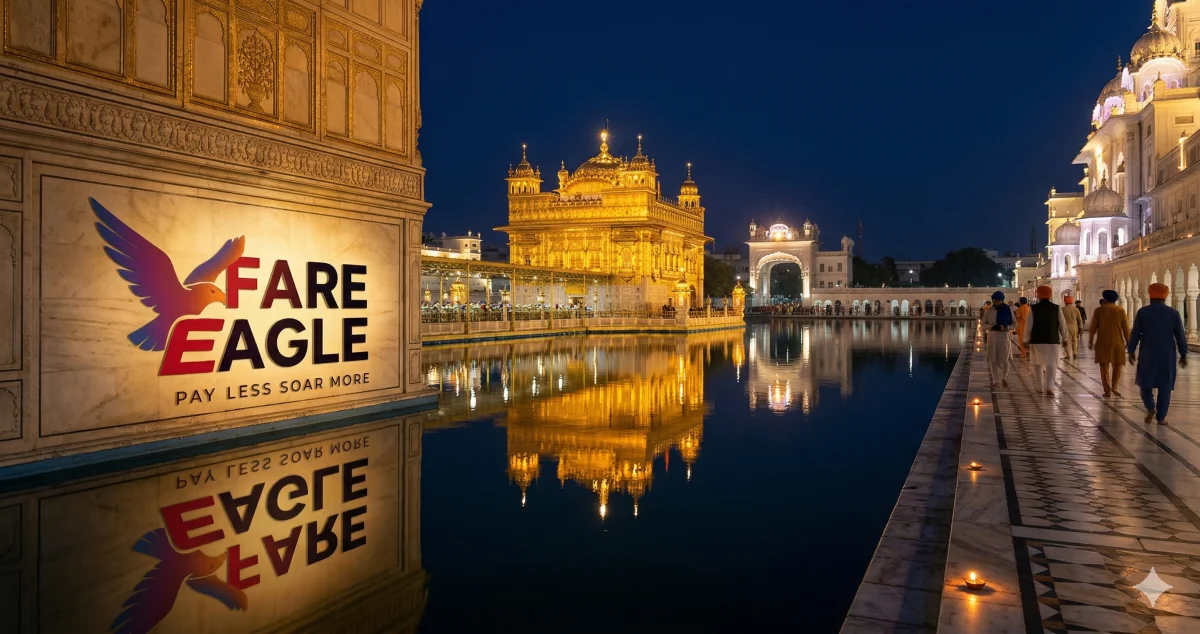
The Golden Temple in Amritsar — Sri Harmandir Sahib — is the holiest shrine in Sikhism, one of the most visited religious sites on Earth, and perhaps the most welcoming sacred space you will ever enter. It is open to everyone, 24 hours a day, 365 days a year, completely free of charge. Its community kitchen (Guru ka Langar) feeds over 100,000 people every single day — the largest free kitchen in the world — regardless of religion, caste, nationality, or wealth. The golden dome reflecting in the sacred pool at dawn, the continuous kirtan echoing through the complex, and the simple act of sitting on the floor beside strangers sharing a meal — this is an experience that changes people. Whether you’re traveling from Delhi, flying in from London, or visiting from the United States, this guide covers everything for your 2026 visit.
About Sri Harmandir Sahib (Golden Temple)
The Golden Temple was founded by Guru Ram Das, the fourth Sikh Guru, in 1577. The construction was completed by Guru Arjan Dev, the fifth Guru, who installed the Adi Granth (the holy Sikh scripture, now called Guru Granth Sahib) inside the temple in 1604. In 1830, Maharaja Ranjit Singh covered the upper floors and dome with gold foil, giving it the iconic golden appearance that earns its popular name.
The temple sits at the centre of the Amrit Sarovar (Pool of Nectar) — a sacred water tank built around the temple. Devotees walk the marble parikrama (circumambulation path) around the pool, and many take a holy dip in the sarovar before darshan. The complex also houses the Akal Takht (the supreme temporal seat of Sikh authority), the Sikh Museum, the Central Sikh Museum, and the massive Langar Hall.
The temple’s four entrances symbolise that it is open to people from all four directions — all castes, all faiths, all nationalities. This is not a metaphor; it is practiced every day. Hindus, Muslims, Christians, atheists, tourists — everyone is genuinely welcome.
Timings & Daily Schedule
The Golden Temple is open 24 hours. You can visit at any time of day or night. However, understanding the daily ritual schedule helps you plan the most meaningful visit:
~3:00–4:00 AM: Palki Sahib ceremony — the Guru Granth Sahib is carried in a golden palanquin from the Akal Takht to the sanctum. The most sacred morning ritual.
4:00–5:30 AM (Amrit Vela): The most spiritually powerful and peaceful time. Fewest crowds, continuous kirtan (hymn singing) begins, the golden dome glows against the dark sky. If you can only visit once, visit at Amrit Vela.
5:30 AM onwards: Asa di Var kirtan (morning hymns). Darshan continues throughout the day with continuous Gurbani recitation.
Sunset: Rehras Sahib (evening prayer). The temple illuminated against the dusk sky with reflections in the sarovar is the most photographed moment.
~9:30–10:00 PM: Sukh-Aasan ceremony — the Guru Granth Sahib is carried back to the Akal Takht for the night in a golden palanquin procession. Witnessing this is deeply moving.
10:00 PM–3:00 AM: The sanctum is closed for cleaning, but the complex remains open for walking, reflection, and langar.
Guru ka Langar — The World’s Largest Free Kitchen
The Langar at Golden Temple serves over 100,000 free vegetarian meals every day (up to 150,000 on festivals and weekends). The kitchen operates 24 hours with meals prepared fresh in rotation. Everyone — regardless of faith, caste, wealth, or nationality — sits on the floor together and eats the same food. This is the living embodiment of Sikh values of equality and seva (selfless service).
The meal: Simple, wholesome, and delicious — roti (fresh flatbread), dal (lentils), sabzi (seasonal vegetables), kheer (sweet rice pudding), and water. All vegetarian, all prepared by volunteers.
How to participate: No booking needed. Walk to the Langar Hall (clearly signposted), remove your shoes, cover your head, sit on the floor in rows, and volunteers will serve you. Eat as much as you want. The entire experience takes 20–30 minutes.
Volunteer (Seva): You can volunteer in the kitchen — chopping vegetables, rolling rotis, serving food, or washing dishes. No registration needed. Just approach any sevadars (volunteers) and express your wish to help. Even 30 minutes of seva is a profoundly meaningful experience.
How to Reach Amritsar from Major Indian Cities
By Air
Sri Guru Ram Dass Jee International Airport (ATQ) is 11–13 km from the Golden Temple (30 minutes by taxi, ₹400–600). It handles both domestic and international flights.
Domestic routes: Delhi (1h, 5+ daily by IndiGo, Air India, SpiceJet, Vistara), Mumbai (2.5h, 2–3 daily), Bengaluru (3h, daily), Chandigarh (connected via road, no direct flight needed).
International routes: London (direct on Air India), Dubai, Doha, Singapore, Kuala Lumpur, Toronto, and several other international destinations — making Amritsar one of the most internationally accessible pilgrimage cities in India.
Compare fares on FareEagle.
By Train
Amritsar Junction (ASR) is a major railway hub, just 2–2.5 km from the Golden Temple (auto ₹50–80, e-rickshaw ₹30–50). Book on IRCTC.
From Delhi: Shatabdi Express (12013/12014) — ~6 hours, morning departure. Swarna Shatabdi, Shan-e-Punjab Express, and Golden Temple Mail also run daily. Multiple daily options.
From Mumbai: Golden Temple Mail (12903/12904) — ~24 hours. Paschim Express via Jaipur also available.
From Kolkata: Amritsar Mail via Delhi/Lucknow — 30–36 hours. Or fly to Delhi and connect by Shatabdi (faster).
From Chandigarh: Multiple daily trains, 3–4 hours. Also excellent bus connectivity (4–5 hours by road).
From Jammu: Direct trains, 5–6 hours. Popular route for devotees combining Golden Temple with Vaishno Devi.
By Road
From Delhi: 450 km via NH44 (Grand Trunk Road), 7–8 hours by car. Excellent highway. Volvo/AC buses from ISBT Kashmere Gate (₹600–1,500, overnight and day services).
From Chandigarh: 230 km, 4–5 hours. Frequent Punjab Roadways and private buses.
From Jammu: 220 km, 5 hours. Popular road route.
How to Reach from Abroad
From the UK
Best route: London Heathrow → Amritsar (Air India direct, ~8.5 hours). One of the most direct international pilgrimage routes in India — land in Amritsar and be at the Golden Temple within 45 minutes of touchdown.
From the United States / Canada
Toronto → Amritsar (Air India direct, ~14 hours). From US cities: fly to Delhi (Air India nonstop from NYC, Chicago, SFO, Washington) then connect to Amritsar (1h domestic flight or 6h Shatabdi train).
Example (New York): Newark → Delhi (Air India, 15h) → Delhi to Amritsar (IndiGo, 1h) → taxi to Golden Temple (30 min).
From the Middle East (Dubai, Doha)
Direct flights to Amritsar from Dubai and Doha on Air India Express and IndiGo (~3.5–4h). Large Punjabi diaspora makes this route well-served.
From Southeast Asia (Singapore, Kuala Lumpur)
Flights from Singapore and KL to Amritsar (connecting via Delhi or direct on select carriers).
What to See & Do
Darshan at Harmandir Sahib: Walk the marble parikrama around the sarovar, cross the causeway (Guru’s Bridge) to the central sanctum, bow before the Guru Granth Sahib. Listen to the continuous kirtan. The golden interior, mirror work, and precious stone inlay are breathtaking.
Holy dip in the Sarovar: The sacred pool is believed to have healing properties. Separate bathing areas for men and women. Many devotees dip before darshan.
Akal Takht: The highest temporal seat of Sikh authority, opposite the main sanctum. Significant historical and political importance in Sikh history.
Sikh Museum: Inside the complex (upper floor of the clock tower entrance). Paintings and artefacts depicting Sikh history, the ten Gurus, and the martyrdom of Sikh warriors. Free entry.
Jallianwala Bagh — 500 metres from the Golden Temple. The site of the 1919 massacre where British troops fired on an unarmed gathering, killing hundreds. A deeply moving memorial. Free entry. Allow 30–45 minutes.
Wagah Border — 28 km from Amritsar. The India–Pakistan border with the famous Beating Retreat ceremony every evening before sunset (~5:15 PM in summer, ~4:30 PM in winter). Free entry, carry ID. Arrive 1.5–2 hours early for good seats. A patriotic, energetic, and unforgettable experience.
Partition Museum — 2 km from the temple. India’s first museum dedicated to the 1947 Partition. Powerful, moving, and important.
Accommodation
Temple Sarai (free/donation): The SGPC (Shiromani Gurdwara Parbandhak Committee) operates sarai (guest rooms) for pilgrims. Basic, clean rooms available on a first-come basis. Ideal for budget pilgrims.
Budget hotels: ₹500–1,500/night near the walled city and Hall Bazaar.
Mid-range to premium: ₹2,000–8,000/night. Hotels on GT Road, Mall Road, and near the railway station.
Book well in advance during Baisakhi (April), Diwali (October/November), and Gurpurab (November) — the city fills up completely.
What to Eat
Amritsar is one of India’s greatest food cities. Beyond the Langar, the city’s street food is legendary.
Amritsari Kulcha: Stuffed flatbread baked in a tandoor, served with chole (chickpea curry) and lassi. The city’s signature dish.
Lassi: Thick, creamy, served in earthen cups from shops near the temple. Amritsar’s lassi is unmatched.
Amritsari Fish Fry: Crispy batter-fried fish from dhaba stalls in Hall Bazaar.
Pind Balluchi, Kesar da Dhaba, Bharawan da Dhaba: Iconic eateries within walking distance of the temple, some operating for 60+ years.
Best Time to Visit
October–March (Winter): Best weather (4–20°C). Peak tourist season. Diwali (October/November) sees the temple illuminated with spectacular fireworks. Gurpurab (November) is the birthday of Guru Nanak — massive celebrations.
April (Baisakhi): The biggest festival — April 14, 2026. The foundation day of the Khalsa. Nagar Kirtan processions, massive crowds, incredible energy. Hot weather (30°C+) but worth it.
May–September (Summer/Monsoon): Very hot in summer (40°C+), followed by monsoon. Fewer tourists. Amrit Vela (pre-dawn) visits are pleasant even in summer.
Practical Tips
Head covering: Mandatory for everyone inside the complex. Free scarves/bandanas are available at the entrance. Carry your own if you prefer.
Footwear: Must be removed and deposited at the free shoe counter (Joda Ghar) before entering. Walk through the shallow foot-wash pool to clean your feet.
Dress code: Modest clothing covering shoulders and legs. No shorts, sleeveless tops, or short skirts. Sikh traditional wear is not required.
Photography: Allowed in the outer complex and around the sarovar. Restricted inside the sanctum and during certain ceremonies. No flash. Follow instructions from sevadars.
Visit timing: Come at least twice — once at Amrit Vela (3–5:30 AM) for the spiritual experience, and once in the evening (7–9 PM) for the illuminated golden glow reflected in the water.
Time needed: 3–4 hours for darshan + parikrama + langar. A full day if including Jallianwala Bagh, Wagah Border, and city food crawl.
Safety: The complex is extremely safe with thorough security checks at all entry points. Valuables are safe but avoid carrying large bags.
Frequently Asked Questions
Is the Golden Temple open to non-Sikhs?
Yes. The Golden Temple welcomes everyone — all religions, all nationalities, all backgrounds. This is a core Sikh principle, not just a policy. You will feel genuinely welcome.
Is there an entry fee?
No. Entry to the Golden Temple and the Langar is completely free, 24 hours a day, 365 days a year.
What is Guru ka Langar?
The world’s largest free community kitchen, serving 100,000+ vegetarian meals daily. Everyone sits on the floor together and eats the same food. No booking needed — just walk in.
Do I need to cover my head?
Yes, mandatory for everyone. Free scarves are available at the entrance.
Can I volunteer?
Yes. No registration needed. Approach any sevadar and offer to help with cooking, serving, cleaning, or shoe management. Even 30 minutes of seva is welcomed.
What time is best for the least crowds?
Amrit Vela (3:00–5:30 AM). Late night (10 PM–midnight) is also quiet. Weekday mornings are less crowded than weekends.
How many days do I need in Amritsar?
2 days ideal: Day 1 — Golden Temple (morning + evening visits) + Jallianwala Bagh + food crawl. Day 2 — Wagah Border ceremony + Partition Museum + shopping in Hall Bazaar. 1 day is possible but rushed.
Waheguru ji ka Khalsa, Waheguru ji ki Fateh.
Compare flights to Amritsar from anywhere in India and abroad on FareEagle.