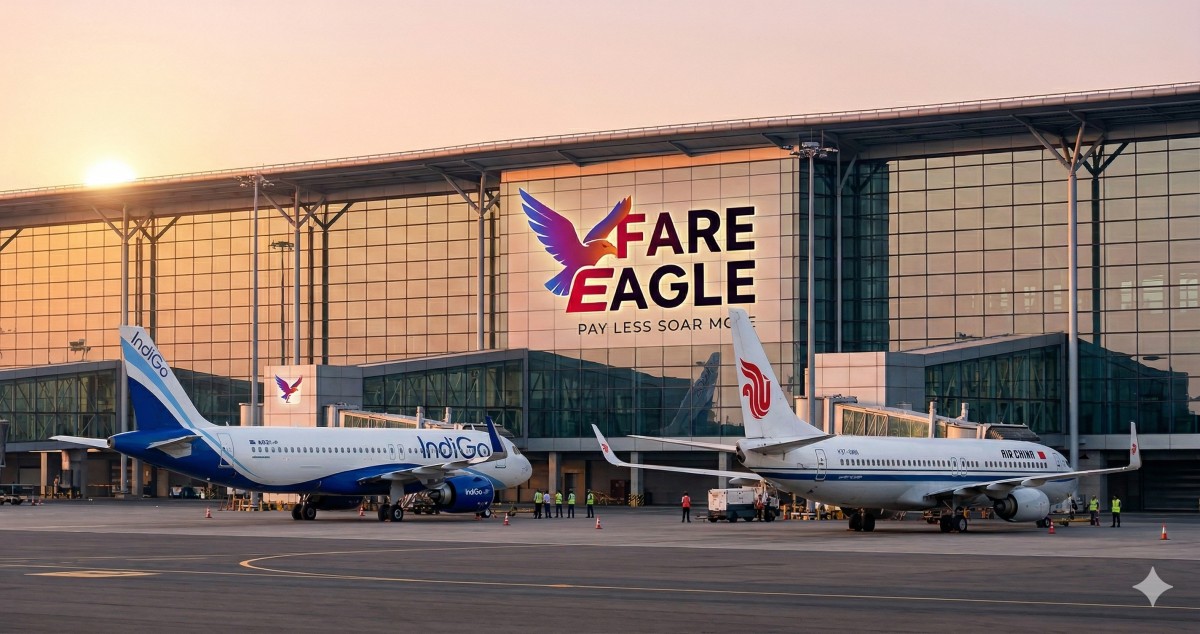
Between 2020 and early 2026, there were essentially no direct flights between India and China. The pandemic grounded everything first. Then border tensions at Ladakh kept diplomatic relations cold enough that neither side pushed to restore air connectivity. If you needed to fly between the world's two most populous countries during this period, you had to route through a third country. Bangkok, Singapore, Hong Kong, Kuala Lumpur. What should have been a 5-6 hour flight became a 12-18 hour journey involving layovers, extra immigration queues, and significantly higher fares.
That era is over. In April 2026, four direct routes have either launched or are about to launch, reconnecting India and China with proper, non-stop air links for the first time in six years.
This isn't just an aviation story. It affects anyone doing business with China, studying there, visiting family, or planning a trip to see the Great Wall and the Shanghai skyline. If that's you, here's everything you need to know.
Every Route: Airlines, Schedules, and Aircraft
Here are all four direct India-China routes operating or launching in April 2026:
1. IndiGo: Kolkata to Shanghai (Daily, Non-Stop)
| Detail | Info |
|---|---|
| Flight Number | 6E 1709 (outbound) / 6E 1710 (return) |
| Route | Kolkata (CCU) to Shanghai Pudong (PVG) |
| Frequency | Daily |
| Departure (Kolkata) | 21:45 IST |
| Arrival (Shanghai) | 04:40 CST (next day) |
| Return Departure (Shanghai) | 05:40 CST |
| Return Arrival (Kolkata) | 09:05 IST |
| Aircraft | Airbus A320neo |
| Started | March 29, 2026 |
This is the headline route, and IndiGo has designed the schedule smartly. The overnight eastbound departure means you leave Kolkata after dinner and arrive in Shanghai early morning, ready for a full working day. The early morning return from Shanghai gets you back to Kolkata by 9 AM, so you don't lose a day travelling back either.
The schedule also works for connecting passengers. IndiGo has synchronized domestic timings so travellers from Delhi, Mumbai, Bengaluru, Hyderabad, Chennai, Ahmedabad, Pune, Jaipur, and Bhubaneswar can connect to Shanghai with a single stop in Kolkata. This positions Kolkata as a serious international transit hub for eastbound traffic, competing with the traditional routing through Singapore or Bangkok.
With this route, IndiGo now operates 21 weekly flights to mainland China, including existing daily services from both Kolkata and Delhi to Guangzhou. That's a significant commitment to the India-China corridor.
2. China Southern: Guangzhou to Delhi
| Detail | Info |
|---|---|
| Route | Guangzhou (CAN) to Delhi (DEL) |
| Frequency | Multiple weekly |
| Aircraft | Wide-body |
| Status | Already operating |
China Southern was actually one of the first to restart, and the route is already flying. Guangzhou is China's southern manufacturing capital, home to the Canton Fair (the world's largest trade fair held twice a year), and a gateway to the entire Pearl River Delta economic zone that includes Shenzhen, Dongguan, and Foshan.
For Indian importers, exporters, and tech professionals, this is probably the most commercially important route in the batch. A huge share of India-China trade flows through Guangzhou and its surrounding industrial belt.
3. China Eastern: Kunming to Kolkata
| Detail | Info |
|---|---|
| Route | Kunming (KMG) to Kolkata (CCU) |
| Frequency | Multiple weekly |
| Launch Date | April 18, 2026 |
This route flies under the radar but matters a lot for a specific audience. Kunming is the capital of Yunnan province in southwestern China and serves as a major transit hub for connections to Southeast Asia. Bangkok, Vientiane, Hanoi are all short flights from Kunming.
Historically, the Kunming-Kolkata sector was one of the busiest India-China routes for traders, especially in the textiles, tea, leather, and engineering goods sectors. Business groups in eastern India had been lobbying for its restoration for years. Its return on April 18 closes one of the last major connectivity gaps left over from the pandemic era.
4. Air China: Beijing to Delhi
| Detail | Info |
|---|---|
| Route | Beijing Capital (PEK) to Delhi (DEL) |
| Frequency | Several weekly |
| Launch Date | April 21, 2026 |
This is the symbolic one. Beijing and Delhi are the political capitals. Reconnecting them with direct flights signals that both governments are serious about normalizing relations beyond just trade.
For travellers, Beijing is one of the richest tourism destinations in Asia. The Great Wall, the Forbidden City, the Temple of Heaven, the Summer Palace, the hutong neighborhoods. A 5-7 day Beijing trip from Delhi is now genuinely practical in a way it hasn't been for six years. No more 15-hour routings through Bangkok with an exhausting layover.
What About Fares?
The biggest impact of direct flights isn't just saving time. It's bringing down fares across the entire India-China corridor.
When the only options were connecting flights through third countries, airlines on those routes had no real pressure to compete on price. A one-stop routing through Singapore or Bangkok could charge a premium because there was no alternative.
Now there is. IndiGo offering a daily non-stop Kolkata-Shanghai flight puts direct pricing pressure on every airline that sells India-China tickets. Singapore Airlines, Thai Airways, Cathay Pacific, and others routing through their hubs will need to price competitively or lose the traffic.
Early indications suggest round-trip fares on the IndiGo Kolkata-Shanghai route are starting around ₹25,000-35,000 in economy. Connecting itineraries through Southeast Asian hubs were typically ₹35,000-55,000 for the same route. That's a meaningful saving, especially for business travellers making multiple trips per year or families planning a holiday.
The fare impact extends beyond just the routes with direct flights. If Delhi-Shanghai non-stop is available via IndiGo (connecting through Kolkata) at ₹30,000, then airlines routing Delhi-Singapore-Shanghai will need to match or beat that price. Competition lifts all boats, or in this case, lowers all fares.
Who Benefits Most
Business travellers and traders: The India-China trade relationship is worth over $100 billion annually. Thousands of Indian business professionals travel to Chinese manufacturing hubs regularly for sourcing, quality inspection, trade fairs, and negotiations. Direct flights save them a full travel day each way. Over a year of monthly trips, that's 24 days of productive time recovered.
Students: China has a growing number of Indian students, particularly in medical and engineering programs. Direct flights make the journey home during breaks much simpler and cheaper.
Tourists: China is one of the most undervisited destinations by Indian travellers relative to its proximity and cultural depth. The Great Wall, the Terracotta Warriors in Xi'an, Shanghai's skyline, the karst mountains of Guilin, the pandas of Chengdu. With direct flights bringing down costs and travel time, expect tourism to pick up significantly.
Exporters and MSMEs: IndiGo has specifically highlighted that the Shanghai route's belly cargo capacity will benefit small and medium enterprises in eastern India. Direct non-stop service can shave a full day off cargo transit times compared to one-stop routings through Southeast Asian hubs. For perishable goods and time-sensitive shipments, that matters.
China Visa for Indians: What You Need
Indian citizens need a visa to visit China. There's no visa-on-arrival or e-visa option. You need to apply in advance through the Chinese Embassy or a VFS Global centre in India.
Here's what the process looks like in 2026:
Tourist Visa (L-type): The standard option for holiday travel. Single entry, valid for 30 days. Processing takes 5-7 working days. Fee is approximately ₹5,500-6,500 depending on processing type (regular vs express).
Documents needed: Valid passport with at least 6 months validity and 2 blank pages. Completed visa application form with a recent passport-size photo. Confirmed round-trip flight booking. Hotel reservation for the entire stay (or invitation letter if staying with family/friends). Bank statement for the last 3 months showing sufficient funds. Travel insurance covering the duration of stay.
Business Visa (M-type): If you're travelling for trade, meetings, or business negotiations. Requires an invitation letter from a Chinese company in addition to the standard documents.
Good news for 2026: China has simplified the L-Visa (tourist) process for Indian tour groups as part of the bilateral normalization. If you're travelling with an approved group tour, the visa process is faster and involves less paperwork. Check with your travel agent for details.
Immigration tip: Chinese airports use biometric entry (fingerprinting) for foreign nationals. The process is straightforward but adds 10-15 minutes to your arrival. Factor this into your connection planning if you're catching an onward domestic flight in China.
Practical Travel Tips
Payments: China runs almost entirely on digital payments (WeChat Pay and Alipay). International credit cards are accepted at large hotels and some restaurants, but for everyday spending (street food, local shops, taxis), you'll need either a Chinese payment app or cash. Some banks now offer international versions of WeChat Pay and Alipay that Indian travellers can set up before departure. Research this before you go.
Internet: Google, WhatsApp, Instagram, and most Western social media platforms are blocked in China. You'll need a VPN if you want to access these services. Download and set up a VPN before you leave India. Also download offline maps (Google Maps works offline; Baidu Maps is the local alternative).
Language: English is not widely spoken outside major hotels and tourist sites in Shanghai and Beijing. Download a translation app (Google Translate works offline if you download the Chinese language pack before your trip) and save a few essential phrases.
Currency: Chinese Yuan (CNY/RMB). As of early 2026, 1 CNY is approximately ₹11.5-12. ATMs are widely available in cities but some have limits on international card withdrawals. Carry some cash in small denominations for markets and street vendors.
Best time to visit: Spring (April-May) and autumn (September-November) offer the most comfortable weather across most Chinese cities. Avoid Chinese New Year (late January/February) and Golden Week (first week of October) when domestic travel surges and prices spike.
What This Means for the Future
Before the pandemic, India and China had over 50 direct flights per week connecting multiple city pairs. We're at roughly 28 weekly flights now with these four routes. The gap is closing but there's still room to grow.
Industry observers expect more routes to follow if demand holds. Potential additions being discussed include Delhi-Shanghai (direct, not via Kolkata), Mumbai-Shanghai, Bengaluru-Guangzhou, and Chennai-Shenzhen. IndiGo, Air India, and Chinese carriers are all reportedly evaluating these city pairs.
For Indian travellers and businesses, the message is simple: the China corridor is open again. The flights are real, the schedules work, and the fares are competitive. If you've been putting off that business trip or tourism plan because of routing headaches, the excuse is gone.
Book India-China Flights
Compare fares across IndiGo, Air China, China Eastern, and China Southern on FareEagle. We show real-time prices so you can find the best deal for your dates.
Search Kolkata to Shanghai Flights
Search Delhi to Beijing Flights
Search Delhi to Guangzhou Flights
Flight schedules, fares, and visa requirements are subject to change. Always verify current information with the airline and the Chinese Embassy before finalising your travel plans.