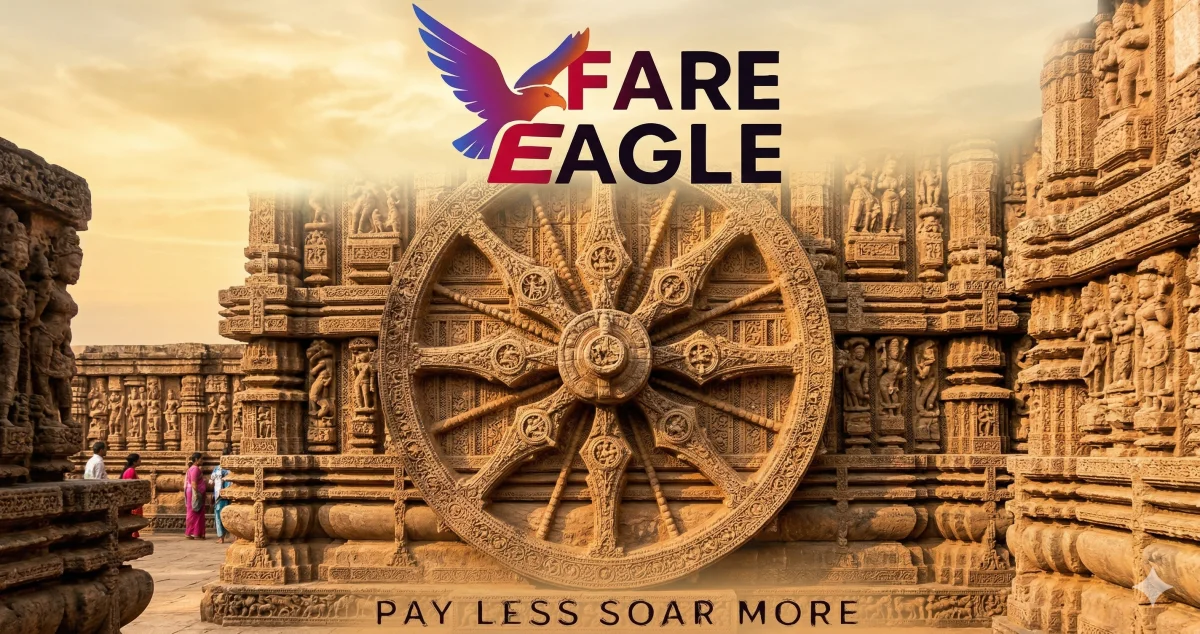
“Here the language of stone surpasses the language of man,” wrote Rabindranath Tagore about the Konark Sun Temple. Built in the 13th century as a colossal stone chariot with 24 intricately carved wheels pulled by seven horses, this UNESCO World Heritage Site is one of the greatest architectural achievements of the ancient world. Unlike most temples in this guide, Konark is not an active place of worship — it is a monument to human ambition and artistic genius, open to visitors of all faiths. Whether you’re combining it with Puri Jagannath Temple, flying into Bhubaneswar, or traveling from abroad, this guide covers everything for your 2026 visit.
About Konark Sun Temple
The Konark Sun Temple was built between 1238–1250 CE by King Narasimhadeva I of the Eastern Ganga Dynasty. Dedicated to Surya (the Sun God), the temple was designed so that the first rays of the rising sun would fall directly on the entrance and illuminate the main idol. The name “Konark” comes from “Kona” (corner/angle) and “Arka” (sun).
The temple was designed as a massive stone chariot: 24 elaborately carved wheels (each ~10 feet in diameter), 7 galloping horses, and walls covered with sculptures depicting gods, mythological scenes, daily life, animals, and erotic figures. The original main tower (Vimana) is estimated to have stood 227 feet tall — one of the tallest temples ever built in India — but it collapsed centuries ago. What survives today is the Jagamohana (audience hall) and the Nata Mandir (dance hall), both still breathtaking in scale and detail.
European sailors called it the “Black Pagoda” (in contrast to Puri’s “White Pagoda”), using it as a navigation landmark. The main structure has been filled with sand by the Archaeological Survey of India (ASI) to prevent further collapse — visitors can admire the exterior but cannot enter the sanctum.
Konark was declared a UNESCO World Heritage Site in 1984.
The 24 Wheels — Ancient Sundials
One of the most fascinating aspects of Konark is that its 24 stone wheels function as precise sundials. Each wheel has 8 major spokes and 8 minor spokes, dividing the day into precise time segments. By observing the shadow cast by the spokes, you can tell the time accurate to the minute. This demonstrates the extraordinary astronomical and mathematical knowledge of 13th-century Odisha.
The 24 wheels are believed to represent the 24 hours of the day (12 pairs for day and night). Each wheel is approximately 10 feet in diameter and carved with elaborate floral and geometric patterns. The hub of each wheel features a different mythological scene. Guides at the temple can show you how to read the time from the wheels — it still works perfectly after 800 years, and watching the shadow move across the spokes and confirm the actual time is one of those moments that stops you in your tracks.
Visiting Hours & Entry Fee
Timings: 6:00 AM – 8:00 PM, open all days of the week, all year round.
Entry fee: ₹40 for Indian citizens and SAARC/BIMSTEC nationals. ₹600 for other foreign nationals. Children under 15 enter free.
Best time to arrive: Before 10:00 AM to beat the crowds and the heat (especially in summer). Sunrise is magical — the temple faces east and the morning light on the stone carvings is extraordinary.
Photography: Allowed throughout the complex (no flash). Tripods may require special permission from ASI.
Time needed: 2–3 hours for a thorough visit. Add 1 hour if attending the Light & Sound Show.
Open to all: Unlike many temples in this guide series, Konark Sun Temple has no religious restrictions. Visitors of all faiths and nationalities are welcome. There is no dress code, though modest clothing is appreciated.
Light & Sound Show
Every evening, the ASI and Odisha Tourism run a spectacular Light & Sound Show that brings the temple’s history and legends to life through dramatic lighting, music, and narration.
Timings: Two shows daily — 6:30 PM & 7:30 PM (December–February), 7:30 PM & 8:20 PM (March–November).
Duration: ~40–60 minutes.
Ticket: ₹70 for Indians, ₹630 for foreign nationals. Wireless headphones provided with narration in English, Hindi, or Odia.
Booking: Available online via the ASI e-ticketing portal or at the venue. Book online during peak season (October–February) as shows sell out.
How to Reach Konark
Konark has no airport or railway station. It is accessed from Puri (35 km) or Bhubaneswar (65 km), both well-connected cities.
From Puri (35 km, 1 hour)
This is the most common route. The Puri–Konark Marine Drive road is one of the most scenic coastal roads in India — the drive itself is a highlight. Options: taxi (₹800–1,200 round trip with waiting), OSRTC/private bus from Puri bus stand (₹30–60, every 30 min, 1 hour), auto-rickshaw (₹400–600 one-way).
From Bhubaneswar (65 km, 1.5–2 hours)
Fly into Biju Patnaik International Airport (BBI), then drive or take a bus to Konark. Taxi from airport: ₹1,500–2,500. OSRTC buses available from Bhubaneswar bus stand (₹60–100, 2 hours).
Key flight routes to Bhubaneswar: Delhi (2.5h, 5+ daily), Mumbai (2.5h, 5+ daily), Kolkata (1h, 5+ daily), Bengaluru (2h, 3+ daily), Hyderabad (1.5h, 3+ daily), Chennai (2h, 2+ daily).
Compare fares on FareEagle.
By Train (to Puri or Bhubaneswar)
Take a train to Puri (PURI) or Bhubaneswar (BBS), then road to Konark. Book on IRCTC.
From Kolkata: Jagannath Express, Puri Express to Puri — 7–10 hours. Multiple daily.
From Delhi: Purushottam Express to Puri — 24–30 hours. Or any train to Bhubaneswar (on the main Kolkata–Chennai line).
From Mumbai: Konark Express to Bhubaneswar — 30–36 hours.
From Chennai: Coromandel Express to Bhubaneswar — 18–22 hours.
From Bengaluru: Prashanti Express to Puri — 30–35 hours.
How to Reach from Abroad
From the United States
Fly to Delhi or Kolkata, connect to Bhubaneswar (BBI). From Bhubaneswar, drive to Konark (1.5 hours). Example: New York → Delhi (Air India, 15h) → Delhi to Bhubaneswar (IndiGo, 2.5h) → drive to Konark.
From the UK
London → Kolkata (direct, 10h) or London → Bhubaneswar (via Delhi, 13–15h). Then road to Konark.
From the Middle East
Dubai → Bhubaneswar (Air India Express, ~4.5h direct). Then taxi to Konark. Or fly to Kolkata and take a train to Puri.
Konark Dance Festival
The Konark Dance Festival (December, usually 1st–5th) is one of India’s most prestigious classical dance events. Performances of Odissi, Bharatanatyam, Kathak, Kuchipudi, and other classical forms take place on an open-air stage with the illuminated Sun Temple as the backdrop. It is a uniquely powerful cultural experience — ancient art performed in front of ancient architecture.
The festival is organised by Odisha Tourism and admission is usually free. Accommodation in Konark and Puri fills up quickly during the festival — book well in advance.
What to See at Konark
The 24 Wheels: Each wheel is a masterpiece of carving and functions as a sundial. Ask a guide to demonstrate.
The 7 Horses: Representing the seven days of the week, pulling the chariot of the Sun God eastward.
Erotic Sculptures: Similar to Khajuraho, the temple walls feature detailed erotic carvings alongside depictions of daily life, mythology, and nature. These are considered expressions of the complete human experience in Hindu philosophy.
Nata Mandir (Dance Hall): A raised platform where temple dancers once performed. Exquisite carvings of musicians and dancers.
ASI Museum: Located nearby, showcasing sculptures and artefacts recovered from the temple complex. ₹5 entry.
Chandrabhaga Beach: 3 km from the temple. A serene, less-crowded beach on the Bay of Bengal. India’s first Blue Flag certified beach. Perfect for a post-temple walk.
Places to Visit Near Konark
Puri Jagannath Temple — 35 km. One of the Char Dhams. Most visitors combine Konark + Puri in one trip.
Bhubaneswar Temples — 65 km. The “Temple City” — Lingaraj Temple, Rajarani Temple, Mukteswara Temple, Udayagiri & Khandagiri Caves.
Chilika Lake — 80 km from Konark. Asia’s largest brackish water lagoon. Irrawaddy dolphins, migratory birds (October–March).
Raghurajpur Artist Village — Between Konark and Puri. A heritage village where every house is adorned with Pattachitra paintings and palm leaf engravings. Fascinating for art lovers.
Ramachandi Temple & Beach — 7 km from Konark. At the confluence of the Kushabhadra River and the Bay of Bengal. Scenic and spiritually significant.
Best Time to Visit
October–February (Winter): Best weather (15–28°C). The Konark Dance Festival (December) and Magha Saptami (January/February — a Sun God festival with a ritual bath at Chandrabhaga Beach at dawn) fall in this window. Peak tourist season.
March–May (Summer): Very hot (35–42°C). Visit before 10 AM or after 4 PM. Fewer crowds.
June–September (Monsoon): Heavy rain. Lush green surroundings but outdoor exploration is limited. Fewest visitors.
Budget Breakdown
| Expense | Budget | Comfortable |
|---|---|---|
| Entry fee | ₹40 | ₹40 |
| Light & Sound Show | ₹70 | ₹70 |
| Transport from Puri (round trip) | ₹60–120 (bus) | ₹800–1,200 (taxi) |
| Guide (optional) | ₹0 (self-guided) | ₹300–500 (ASI-approved) |
| Food & refreshments | ₹100–200 | ₹300–500 |
Konark is typically visited as a day trip from Puri or Bhubaneswar, so accommodation costs are usually part of your Puri/Bhubaneswar stay. If you want to stay overnight in Konark: OTDC Panthanivas (government hotel, ₹1,000–3,000/night) or private options like Lotus Hotel and Sun Temple Hotel (₹500–2,500/night).
Practical Tips
Hire a guide: Konark’s architecture, symbolism, and astronomy are too rich to appreciate without context. ASI-approved guides (₹300–500) dramatically improve the experience. They can demonstrate how the wheel-sundials work, explain the sculpture panels, and share the temple’s history.
Arrive at sunrise: The temple faces east. The morning light on the stone carvings is spectacular and the complex is near-empty before tour groups arrive (~10 AM).
Combine with Puri: Konark + Puri Jagannath Temple + Chandrabhaga Beach makes a perfect full-day itinerary. The Puri–Konark Marine Drive is scenic enough to be an attraction in itself.
Footwear: Wear comfortable walking shoes. The complex is large with uneven surfaces. Flip-flops are fine but less practical for extended exploration.
Sun protection: Limited shade inside the complex. Carry water, sunscreen, hat/umbrella — essential in summer.
Konark Dance Festival: If visiting in December, check the exact dates and plan around the festival. Performances are in the evening against the lit-up temple — unforgettable.
No food/drinks inside: Refreshment stalls are outside the complex. Eat before entering or after.
Frequently Asked Questions
Is Konark Sun Temple still a functioning temple?
No. It is a monument managed by the Archaeological Survey of India (ASI). The main sanctum collapsed centuries ago and has been filled with sand for preservation. It is not an active place of worship, though the annual Magha Saptami festival still draws devotees to nearby Chandrabhaga Beach.
Can non-Hindus visit?
Yes. Konark is open to visitors of all faiths and nationalities. There are no religious restrictions or dress codes (though modest clothing is appreciated).
How do I reach Konark without a car?
Take a bus from Puri bus stand (₹30–60, every 30 min, 1 hour) or from Bhubaneswar (₹60–100, 2 hours). Auto-rickshaws are available from Puri (₹400–600 one-way).
Is it worth visiting?
Absolutely. Even in its partially ruined state, Konark is one of the most impressive ancient structures you will ever see. The scale, detail, and astronomical precision are genuinely awe-inspiring. Budget at least 2–3 hours.
What is the best time to visit?
October–February for weather. December for the Konark Dance Festival. Arrive before 10 AM any time of year for the best light and fewest crowds.
Can I enter the main temple structure?
No. The main structure (Jagamohana) is sealed and filled with sand for preservation. You can walk around the exterior and admire the carvings up close.
How many days do I need?
Konark itself is a half-day visit (2–3 hours + Light & Sound Show in evening). Most visitors combine it as a day trip from Puri (35 km) or Bhubaneswar (65 km) as part of a larger Odisha itinerary.
Where the language of stone surpasses the language of man.
Fly to Bhubaneswar, drive to Konark.