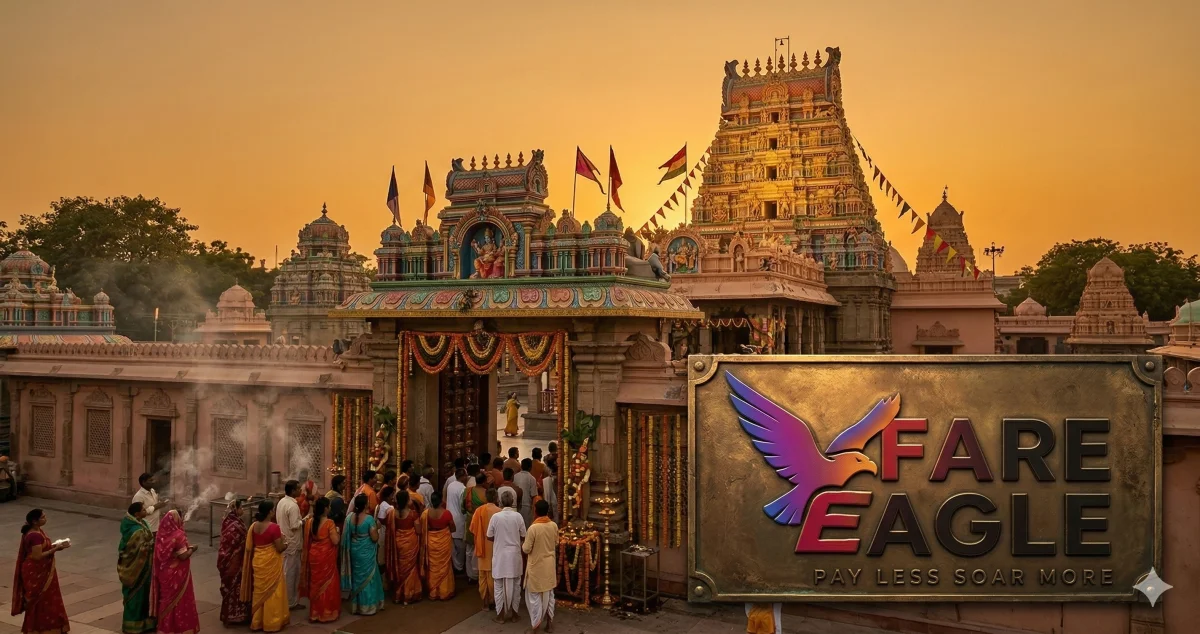
Mathura is where it all begins — the birthplace of Lord Krishna, the eighth avatar of Vishnu, born in a prison cell to Vasudeva and Devaki while the tyrant king Kansa plotted to kill him. The Shri Krishna Janmabhoomi Temple complex stands on the exact spot of that birth, and it remains one of the most emotionally charged pilgrimage sites in India. But Mathura is not just one temple — it is the gateway to the entire Braj region: Vrindavan (where Krishna spent his childhood), Gokul (where he was raised by Yashoda), Govardhan (where he lifted the mountain), and Barsana (birthplace of Radha). Together, these form the most complete Krishna pilgrimage circuit in the world. Whether you’re driving from Delhi, combining with an Agra trip, or flying in from abroad, this guide covers everything for your 2026 visit.
About Shri Krishna Janmabhoomi Temple
The temple complex is built around the sacred prison cell (Garbha Griha) where Lord Krishna was born. According to the Bhagavata Purana, when Krishna was born at midnight, the prison doors miraculously opened, the guards fell asleep, and Vasudeva carried the newborn across the flooding Yamuna River to safety in Gokul. The original temple on this site is believed to have been built by Vajranabha (Krishna’s great-grandson) over 5,000 years ago. It was expanded during the Gupta Empire (4th century CE), destroyed and rebuilt multiple times through history, and the current structure incorporates both ancient ruins and modern construction.
The complex includes the Keshavdeo Temple (main shrine with Radha-Krishna idols), the Bhagavata Bhavan (depicting Krishna’s life through murals and dioramas), and the Garbha Griha — the atmospheric underground prison cell that is the spiritual heart of the complex. Standing in the actual cell where Krishna is believed to have been born is a profoundly moving experience.
Darshan Timings
Morning: 5:00 AM – 12:00 PM
Evening: 4:00 PM – 8:30 PM
Closed between 12:00 PM and 4:00 PM for bhog and deity rest.
Key aarti timings:
5:30 AM: Mangala Aarti (dawn)
~11:30 AM: Shringaar Aarti
~6:00 PM: Sandhya Aarti (evening — the most atmospheric)
~8:00 PM: Shayan Aarti (night)
Best darshan time: 5:00–8:00 AM for the shortest queues and most peaceful experience. Evening aarti (6:00 PM) is the most powerful — the sound of bells echoing off the stone walls in the lamplight is unforgettable.
Entry & Tickets
Entry is free. No tickets required for general darshan. VIP/fast-track darshan may be available during peak seasons (₹500–1,000) but is typically suspended during Janmashtami and Holi when all darshan is general.
Sevas (Abhishekam, Pushpanjali, etc.) can be booked at the temple counter or online via the official Krishna Janmabhoomi website.
Important: No mobile phones, cameras, or electronic devices inside the temple complex. Security is strict (airport-level screening). Deposit devices at lockers near the entrance. No photography allowed anywhere inside. Dress code: modest traditional Indian attire required.
How to Reach Mathura
By Train (Best Option)
Mathura Junction (MTJ) is one of the best-connected railway junctions in North India, just 4 km from the Krishna Janmabhoomi Temple (auto ₹30–80). Book on IRCTC.
From Delhi: Multiple daily trains, 2–3 hours. Taj Express, Bhopal Shatabdi (stops at Mathura), and many others. One of the most frequent train routes in India.
From Agra: Just 60 km, 1 hour by train. Extremely frequent — almost every hour.
From Mumbai: Multiple daily trains via Kota or Agra, 14–18 hours.
From Jaipur: Direct trains, 5–6 hours.
From Lucknow: Direct trains, 7–8 hours.
From Varanasi: Direct trains, 10–12 hours. Popular route for pilgrims combining Kashi + Mathura.
By Road
From Delhi: 150 km via the excellent Yamuna Expressway, 2.5–3 hours. One of India’s best highways. Frequent buses from ISBT Kashmere Gate (₹200–500). Perfect weekend trip from Delhi/NCR.
From Agra: 60 km, 1–1.5 hours. The Taj Mahal + Mathura-Vrindavan is India’s most popular 2-day combo trip.
From Jaipur: 280 km, 4–5 hours via NH21.
By Air
Mathura has no airport. Nearest airports:
Agra Airport (AGR): 60 km from Mathura. Limited domestic flights.
Delhi IGI Airport (DEL): 150 km from Mathura (3 hours via Yamuna Expressway). India’s most connected airport with nonstop flights from USA, UK, Dubai, Singapore, and every Indian city.
Compare fares on FareEagle.
How to Reach from Abroad
Fly to Delhi (DEL), then drive to Mathura (150 km, 3 hours via Yamuna Expressway). Delhi has nonstop flights from New York, Chicago, San Francisco, London, Toronto, Dubai, Singapore, and 60+ international cities.
Example (USA): New York → Delhi (Air India, 15h) → car/taxi to Mathura (3h via Yamuna Expressway).
Example (UK): London → Delhi (8–9h nonstop) → Mathura (3h by road or 2.5h by train).
Example (Dubai): Dubai → Delhi (3.5h) → Mathura (3h by road).
Janmashtami at Mathura (September 2026)
Krishna Janmashtami 2026 falls on approximately September 4–6, 2026 (Ashtami Tithi). This is the most significant festival at Mathura — celebrating the exact moment of Krishna’s birth at midnight.
Midnight darshan: The temple opens special midnight darshan starting around 2:00 AM and continuing until 6:00 AM — the atmosphere during this period is electric. Thousands of devotees gather to witness the moment of Krishna’s birth re-enacted with elaborate decorations, kirtan, and aarti.
Crowds: Lakhs of pilgrims. All VIP passes suspended. General queue can take 4–6+ hours. Book accommodation months in advance — the entire Braj region fills up.
Holi at Mathura & Vrindavan
Holi in Mathura, Vrindavan, Barsana, and Nandgaon is considered the most authentic Holi celebration in the world. The festivities span 7–10 days starting before the official Holi date:
Lathmar Holi (Barsana): Women beat men with sticks — recreating the legend of Krishna visiting Radha’s village. The most famous Holi event in India.
Phoolon ki Holi (Vrindavan): Flower Holi at Banke Bihari Temple — devotees are showered with petals instead of colours. Extraordinarily beautiful.
Holi at Krishna Janmabhoomi: Grand celebrations with colours, kirtan, and processions.
Book Holi packages well in advance — accommodation sells out months ahead.
Key Temples in Mathura City
Dwarkadhish Temple: One of Mathura’s most beautiful and historically significant temples, built in 1814 by Seth Gokuldas Parikh. Dedicated to Lord Krishna as the King of Dwarka. Stunning architecture with intricate carvings, painted ceilings, and vibrant decorations. The Swing Festival (Jhulan Yatra) in August and Holi celebrations here are magnificent. Timings: ~6:30 AM–12:00 PM & 4:00 PM–10:30 PM.
Vishram Ghat: The most sacred ghat on the Yamuna in Mathura — believed to be the spot where Krishna rested after slaying Kansa. There are 25 ghats along the Yamuna, but Vishram Ghat is the spiritual centre. The evening aarti at Vishram Ghat (with oil lamps floating on the river) is one of Mathura’s most beautiful daily rituals and should not be missed.
Mathura Museum (Government Museum): Houses one of India’s finest collections of Kushan and Gupta-era sculptures, including rare headless Buddha statues, Mathura school of art masterpieces, and ancient coins. Entry ₹20. A fascinating 1-hour visit for history enthusiasts.
The Complete Braj Circuit (Mathura + Vrindavan + Beyond)
Vrindavan (15 km from Mathura): Where Krishna spent his childhood. Key temples:
Banke Bihari Temple: The most beloved Krishna temple in Vrindavan. Unique curtain darshan (opens and closes repeatedly). Extremely crowded — go early morning.
ISKCON Vrindavan (Sri Krishna Balaram Mandir): Grand, well-organised temple with beautiful deities. Excellent for international visitors. Mangala Aarti (4:30 AM) is powerful.
Prem Mandir: A stunning modern temple with evening light shows. Open to all, free entry. One of the most beautiful temples in North India.
Radha Raman Temple: A 16th-century temple housing a self-manifested deity. Deeply revered by scholars and traditionalists.
Nidhivan: A mysterious grove where Krishna and Radha are believed to perform Ras Leela every night. Closed after sunset — no one is allowed to stay inside after dark.
Govardhan (25 km): The hill Krishna lifted on his little finger to protect villagers from Indra’s rain. The 21-km Govardhan Parikrama (circumambulation) is one of the most important pilgrimages in the Braj region. Thousands walk the parikrama barefoot every day — it takes 5–7 hours. The hill is worshipped as a form of Krishna himself, and devotees offer prayers at the Daan Ghati Temple and Mansi Ganga lake along the route.
Gokul (15 km): Where Krishna was raised by foster parents Nanda and Yashoda. Peaceful and less crowded than Mathura/Vrindavan.
Barsana (45 km): Birthplace of Radha. Temple on Bhanugarh hill. Famous for Lathmar Holi.
Accommodation
Dharamshalas: ₹200–800/night in both Mathura and Vrindavan. Basic but clean.
Budget hotels: ₹800–2,000/night near Mathura Junction and in Vrindavan town.
Mid-range to premium: ₹2,000–8,000/night. Options along the Yamuna Expressway and in Vrindavan.
Book early during Janmashtami (September), Holi (February/March), and Kartik Purnima (November).
What to Eat
Mathura and Vrindavan are strictly vegetarian. The food is Braj-UP style with a focus on dairy (Krishna is the divine cowherd, after all).
Mathura Pedha: The city’s signature sweet — a dense milk-based confection. Buy from shops near the temple. Brijwasi is the most famous brand.
Lassi: Thick, creamy, served cold. Mathura’s lassi rivals Amritsar’s.
Chaat: Kachori-sabzi, aloo tikki, golgappa. Street food near Vishram Ghat is excellent.
Thali meals: ₹60–150 at restaurants near temples.
Best Time to Visit
October–March (Winter): Best weather (8–25°C). Comfortable for temple hopping and Govardhan Parikrama.
February/March (Holi): The most spectacular Holi celebrations in the world. Hot but absolutely worth it.
September (Janmashtami): Krishna’s birthday. Midnight celebrations. Massive crowds.
April–June (Summer): Extremely hot (40–47°C). Early morning visits only.
Practical Tips
Plan 2–3 days: Day 1: Mathura (Janmabhoomi, Dwarkadhish, Vishram Ghat). Day 2: Vrindavan (Banke Bihari, ISKCON, Prem Mandir, Nidhivan). Day 3: Govardhan Parikrama + Gokul/Barsana. One day is too rushed.
Start early: 5:00–7:00 AM is the sweet spot. Crowds build after 10:00 AM and temples close by noon.
No electronics at Janmabhoomi: Strict security. Leave phones at your hotel to save locker time.
Dress code: Traditional Indian attire at all temples. No shorts, sleeveless tops.
Combine with Agra: Mathura is just 60 km from the Taj Mahal. Agra (Taj + Agra Fort) + Mathura-Vrindavan is a classic 3–4 day Golden Triangle extension.
E-rickshaws: The main transport within Mathura and Vrindavan. Cheap (₹10–30 per ride) and available everywhere.
Frequently Asked Questions
Is Krishna Janmabhoomi the birthplace of Lord Krishna?
Yes. The temple complex is built on the site believed to be the exact spot where Lord Krishna was born in a prison cell to Vasudeva and Devaki.
Is entry free?
Yes. All major temples in Mathura and Vrindavan are free to enter. VIP options may be available during peak seasons.
How far is Vrindavan from Mathura?
15 km, 30–45 minutes by auto-rickshaw or taxi depending on traffic.
Can I do Mathura and Vrindavan in one day?
Possible but rushed. You can cover 3–4 major temples in one long day. 2–3 days is recommended for a complete experience.
When is Janmashtami 2026?
Approximately September 4–6, 2026 (Ashtami Tithi). Midnight darshan begins around 2:00 AM. Book accommodation months in advance.
How do I reach Mathura from Delhi?
By road: 150 km via Yamuna Expressway, 2.5–3 hours. By train: 2–3 hours, multiple daily services from New Delhi station. This is one of the easiest pilgrimages from Delhi.
Can I combine Mathura with Agra?
Absolutely. Agra (Taj Mahal) is just 60 km from Mathura. The Agra + Mathura-Vrindavan combo is one of India’s most popular 3–4 day trips.
Jai Shri Radhe Krishna.
Compare flights to Delhi and drive to Mathura on FareEagle.