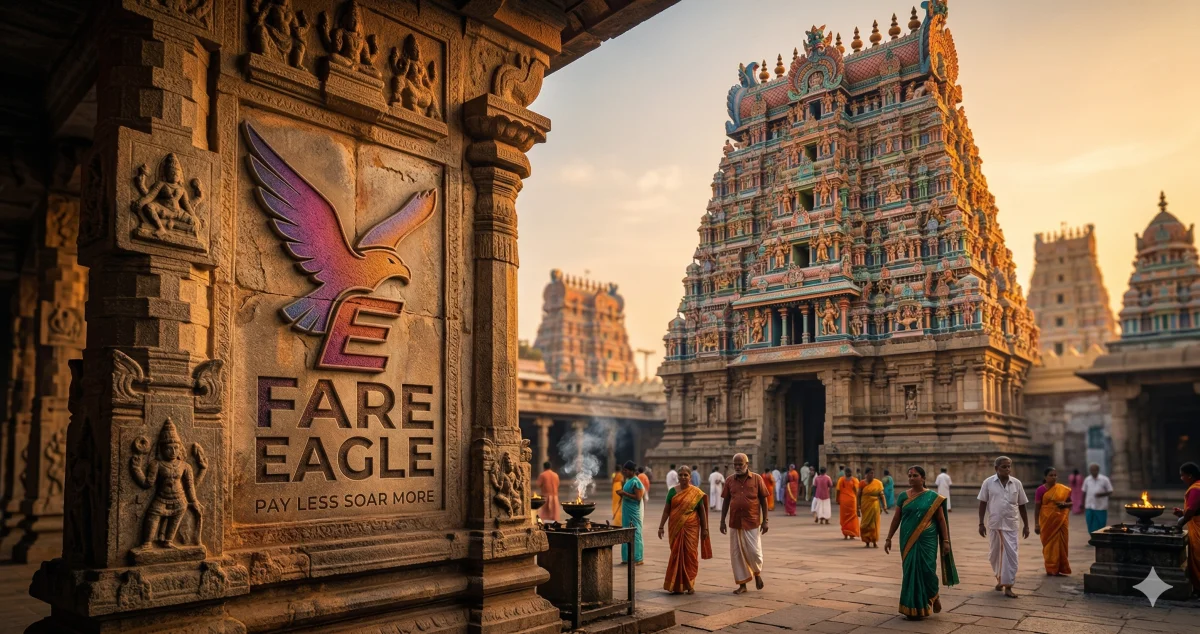
The Meenakshi Amman Temple in Madurai is not just a temple — it is the living heartbeat of one of the oldest continuously inhabited cities on Earth. Spread across 45 acres with 14 towering gopurams covered in thousands of colourful sculpted figures, this is the finest example of Dravidian temple architecture in existence. It was nominated for the New Seven Wonders of the World, and anyone who visits understands why. The temple is dedicated to Goddess Meenakshi (a form of Parvati) and her consort Lord Sundareswarar (Shiva), making it one of the rare temples where the Goddess is the primary deity. Whether you’re traveling from Chennai, flying in from Delhi, or arriving from the United States, this guide covers every detail for your Madurai pilgrimage in 2026.
About Meenakshi Amman Temple
The Arulmigu Meenakshi Sundareswarar Temple dates back over 2,500 years, with the present structure largely built during the Nayak dynasty (16th–17th century) after Madurai was destroyed during medieval invasions. The temple is one of the 275 Paadal Petra Sthalams (Shiva temples revered in 7th–9th century Tamil hymns) and is considered as culturally significant to South India as the Taj Mahal is to North India.
The temple complex is a city within a city: 14 gopurams (the tallest is 52 metres), the Hall of 1,000 Pillars (Aayiramkaal Mandapam) with its famous musical pillars, the Golden Lotus Tank (Porthamarai Kulam), the Ashta Shakti Mandapam, and separate grand shrines for both Goddess Meenakshi and Lord Sundareswarar. The temple is managed by the HR&CE (Hindu Religious and Charitable Endowments) Department of Tamil Nadu.
The most iconic daily ceremony is the night ritual (Palliarai) where Lord Sundareswarar is ceremonially carried in a palanquin to Goddess Meenakshi’s chamber — symbolising the divine couple’s nightly reunion. This evening procession is considered one of the most beautiful temple rituals in India.
Darshan Timings
Morning session: 5:00 AM – 12:30 PM
Evening session: 4:00 PM – 10:00 PM
The temple closes between 12:30 PM and 4:00 PM for naivedyam. Key ritual timings:
5:00 AM: Temple opens, Thiruvanandal (morning ritual)
~6:30 AM: Thrikalasandhi Puja
~11:30 AM: Uchikkal Puja (late morning)
~5:30 PM: Maalai Aarti (evening lamp ceremony)
~9:00–9:30 PM: Palliarai ceremony — the night ritual. Lord Sundareswarar is carried to Meenakshi’s chamber. This is the must-see ceremony.
Darshan Types
Free darshan: Available to all. Queue time: 30 min–2 hours on normal days, 3–5 hours during festivals.
Special/VIP darshan: ₹50–100. Faster entry, separate queue. Book online via the Tamil Nadu HR&CE portal. Book 1–3 days ahead for weekends and festivals.
Special pujas: Laksharchana, Abhishekam, Kalyanam (divine wedding re-enactment) — bookable online or at the temple office.
Important: Mobile phones, cameras, and smartwatches are strictly prohibited inside the temple. Deposit them at the locker facility near the entrance (₹5–10). Photography is not allowed anywhere inside the temple complex.
How to Reach Madurai from Major Indian Cities
By Air
Madurai Airport (IXM) is just 12 km from the temple (20–30 minutes by taxi, ₹300–500). It handles both domestic and select international flights.
Domestic routes: Chennai (1h, multiple daily by IndiGo, Air India), Bengaluru (1h, daily), Delhi (3h, daily by IndiGo), Mumbai (2h, daily), Hyderabad (1.5h, daily), Coimbatore (45 min).
International routes: Dubai, Singapore, Colombo — direct or one-stop flights.
Compare fares on FareEagle.
By Train
Madurai Junction (MDU) is one of the best-connected railway stations in South India, just 2 km from the temple (auto ₹30–50, walking distance). Book on IRCTC.
From Chennai: Vaigai Express, Pandian Express — 7–8 hours. Multiple daily services. One of the most popular pilgrimage routes in Tamil Nadu.
From Bengaluru: Tuticorin Express, Bengaluru–Madurai Express — 10–12 hours overnight.
From Delhi: Grand Trunk Express (via Chennai) or Rajdhani to Chennai + connect. Direct Delhi–Madurai trains take 36–40 hours.
From Mumbai: Mumbai–Nagercoil Express via Madurai — 24–28 hours.
From Kolkata: Coromandel Express to Chennai, then connect to Madurai (total 30+ hours).
From Kochi/Trivandrum: Multiple daily trains, 5–7 hours. Popular route for Kerala devotees.
From Rameshwaram: Direct trains, 3–4 hours. Many pilgrims combine Madurai + Rameshwaram in one trip.
By Road
From Chennai: 460 km via NH85, 7–8 hours by car. TNSTC and private buses (AC Volvo: ₹600–1,200, overnight).
From Bengaluru: 435 km via NH44, 7–8 hours. Frequent KSRTC and private buses.
From Rameshwaram: 170 km, 3–4 hours. Regular buses.
From Kanyakumari: 245 km, 5 hours. Regular buses.
How to Reach Madurai from Abroad
From the United States
Best route: Fly to Chennai (MAA) via Dubai, Doha, or Delhi, then connect to Madurai (1h domestic flight or 7–8h train/bus).
Example (New York): Newark → Dubai (Emirates, 12h) → Madurai (direct flight from Dubai, available on select airlines) or Dubai → Chennai (4h) → Madurai (1h flight).
Example (Chicago): Chicago → Hyderabad (Air India nonstop, 16h) → Madurai (IndiGo, 1.5h).
From the UK
London → Chennai (Air India nonstop, 10h) → Madurai (1h domestic flight or 7h Vaigai Express train).
From the Middle East (Dubai)
Direct flights from Dubai to Madurai are available (Air India Express, IndiGo — ~4h). This is one of the most convenient international routes for Meenakshi Temple pilgrims.
From Singapore / Sri Lanka
Flights from Singapore to Madurai (via Chennai or direct on select carriers, ~4.5h). Colombo to Madurai flights are also available (~1.5h).
Chithirai Festival — The Grand Divine Wedding
The Chithirai Brahmotsavam (April) is the grandest festival at Meenakshi Temple — a 12-day celebration of the divine wedding (Thirukalyanam) of Goddess Meenakshi and Lord Sundareswarar. On the 10th day, the wedding ceremony is attended by millions of devotees. Lord Vishnu, in the form of Alagar, arrives from Alagar Kovil (21 km away) to “give away” his sister Meenakshi in marriage — a remarkable ritual where both Vaishnavite and Shaivite traditions converge.
Other major festivals: Navaratri (September/October), Teppam (Float Festival) in the Tamil month of Thai (January), and Aavani Moola Festival (August — coronation of Sundareswarar).
What to See Inside the Temple
Goddess Meenakshi Shrine: The primary sanctum. The green-saree-clad goddess holding a parrot. Separate darshan queue.
Lord Sundareswarar Shrine: The Shiva sanctum with a massive Lingam. Separate queue.
Golden Lotus Tank (Porthamarai Kulam): A sacred water tank surrounded by pillared corridors. Tamil literary tradition holds that works were tested here — only those that floated were considered worthy.
Hall of 1,000 Pillars (Aayiramkaal Mandapam): Actually has 985 intricately carved pillars. Some are musical pillars — tap them and they produce musical notes. Now houses an art museum (₹10 entry).
Ashta Shakti Mandapam: The entrance hall with eight forms of Goddess Shakti depicted in stunning sculpture panels.
Killikoondu Mandapam: The parrot cage enclosure near Meenakshi’s shrine, where green parrots are kept — the parrot is Meenakshi’s sacred emblem and appears in her hand in every depiction.
Nayakkar Mandapam: Features exquisite stone carvings depicting scenes from the Thiruvilaiyadal Puranam (divine sports of Shiva). Each pillar tells a different mythological story.
Oonjal Mandapam: The swing mandapam where the deities are placed on a golden swing during festivals. The intricate ceiling paintings here are among the finest in any South Indian temple.
Accommodation
Budget: Dharamshalas and lodges near the temple from ₹300–1,000/night. The temple trust operates basic accommodation.
Mid-range: Hotels on West Masi Street and Town Hall Road, ₹1,000–3,000/night.
Premium: Heritage hotels like the former Thirumalai Nayakkar Mahal area, ₹3,000–10,000/night.
Book well in advance during Chithirai Festival (April) and Navaratri (September/October).
What to Eat
Madurai is a legendary food city. While the temple area is strictly vegetarian, Madurai itself is famous for both vegetarian and non-vegetarian cuisine.
Temple Annadanam: Free vegetarian meals served to devotees.
Jigarthanda: Madurai’s iconic cold drink — milk, almond gum, sarsaparilla syrup, and ice cream. Available at Famous Jigarthanda stall near the temple. A must-try.
Idiyappam, Kothu Parotta, Filter Coffee: Madurai’s street food is exceptional. Restaurants near the temple serve excellent South Indian thali meals for ₹80–200.
Chettinad cuisine: If you venture outside the temple zone, Madurai is gateway to the Chettinad region — one of India’s most distinctive culinary traditions.
Places to Visit Near Madurai
Thirumalai Nayakkar Mahal — 2 km from the temple. A 17th-century palace with stunning Indo-Saracenic architecture. Sound & light show in the evening.
Alagar Kovil — 21 km from Madurai. A beautiful Vishnu temple in the Alagar Hills. Key part of the Chithirai Festival — Lord Alagar’s procession to Madurai is a massive event.
Rameshwaram — 170 km from Madurai. One of the Char Dhams, famous Jyotirlinga, and the Pamban Bridge. 3–4 hours by road. Many pilgrims combine Madurai + Rameshwaram.
Kanyakumari — 245 km from Madurai. The southernmost tip of India where three oceans meet. 5 hours by road.
Kodaikanal — 120 km from Madurai. Hill station at 7,000 feet. 3–4 hours by road. Perfect 2-day add-on.
Best Time to Visit
October–March (Winter): Best weather (18–30°C). Peak pilgrim and tourist season. Navaratri (September/October) and Teppam Festival (January) fall in this window.
April (Chithirai Festival): Hot (35–40°C) but spiritually the most significant month. The 12-day divine wedding festival draws millions. Book accommodation and transport months ahead.
May–September: Very hot (April–June, 35–42°C) then monsoon (October–November). Fewer crowds. Budget-friendly.
Budget Breakdown
| Expense | Budget | Comfortable |
|---|---|---|
| Temple darshan | Free | ₹50–100 (special darshan) |
| Accommodation (1–2 nights) | ₹300–1,000 | ₹1,500–5,000 |
| Food (1–2 days) | ₹200–400 | ₹400–800 |
| Local transport | ₹50–200 | ₹300–800 |
Practical Tips
Dress code: Strict. Men: dhoti/formal pants with shirt (no shorts or sleeveless). Women: saree/salwar kameez (no Western wear). You will be denied entry for non-compliance.
No electronics: Phones, cameras, smartwatches must be deposited at lockers near the entrance. This rule is strictly enforced.
Separate queues: Goddess Meenakshi and Lord Sundareswarar have separate darshan queues. Plan time for both — allow 2–3 hours total on normal days.
Best darshan time: Early morning (5:00–7:00 AM) for shortest queues. The Palliarai evening ceremony (9:00–9:30 PM) is the most spectacular ritual — try to be inside the temple by 8:30 PM.
Language: Tamil is the primary language. Hindi and English are limited outside hotels. Auto drivers may not speak Hindi — show your destination on Google Maps.
Guides: Government-approved guides are available but expensive (₹500–1,500). Worth it if you want to understand the temple’s history, architecture, and symbolism in depth.
Combine trips: Madurai + Rameshwaram (170 km) + Kanyakumari (245 km) makes a powerful 4–5 day Tamil Nadu pilgrimage circuit. Add Kodaikanal for a hill station break.
Frequently Asked Questions
What are Meenakshi Temple darshan timings?
Morning: 5:00 AM – 12:30 PM. Evening: 4:00 PM – 10:00 PM. Closed 12:30 PM – 4:00 PM. The Palliarai (night) ceremony around 9:00–9:30 PM is the highlight.
Is there an entry fee?
No. General darshan is completely free. Special/VIP darshan costs ₹50–100 and can be booked online via the HR&CE portal.
Can non-Hindus visit?
Non-Hindus can enter the outer areas of the temple complex and admire the gopurams, mandapams, and Golden Lotus Tank. Only Hindus are allowed into the inner sanctums of Goddess Meenakshi and Lord Sundareswarar.
Can I carry my phone inside?
No. All mobile phones, cameras, and electronic devices must be deposited at the locker facility near the entrance.
Does Madurai have an airport?
Yes. Madurai Airport (IXM) is 12 km from the temple with domestic flights from Chennai, Bengaluru, Delhi, Mumbai, and Hyderabad, plus international flights from Dubai, Singapore, and Colombo.
How many days do I need?
1–2 days for Meenakshi Temple and Madurai city. 4–5 days if combining with Rameshwaram and Kanyakumari. During Chithirai Festival (April), plan 2–3 days in Madurai alone.
What is the Palliarai ceremony?
Every night around 9:00–9:30 PM, Lord Sundareswarar is ceremonially carried in a palanquin to Goddess Meenakshi’s chamber — symbolising the divine couple’s nightly reunion. It is one of the most beautiful and unique temple rituals in India.
Experience the divine wedding city.
Compare flights to Madurai from anywhere in India on FareEagle.