🔄 Updated March 26, 2026 — Added fare impact data, fuel surcharges, Air India rescue flight numbers, and Pakistan airspace closure extension. Original article published March 20.
If you have an upcoming flight on Emirates, Qatar Airways, or Etihad — whether it's a direct booking or a connecting flight through Dubai, Doha, or Abu Dhabi — you're probably wondering what to do right now.
The ongoing conflict in the Gulf region has thrown Middle Eastern aviation into unprecedented disruption. Flights are being cancelled, schedules are changing daily, and the three major Gulf carriers that millions of Indian travellers depend on are operating in crisis mode.
Here's a practical guide for Indian passengers on what's happening, what your options are, and how to protect your travel plans.
Current Travel Waivers (as of March 20, 2026)
All three major Gulf carriers have issued travel waivers allowing free changes or cancellations for upcoming bookings:
| Airline | Waiver Covers | What You Can Do |
|---|---|---|
| Emirates | Travel through April 15, 2026 | Free date change or refund |
| Etihad | Travel through April 15, 2026 | Free date change or refund |
| Qatar Airways | Travel through March 28, 2026 | Free date change or refund |
Important: These waivers are being updated regularly. If the conflict continues, they will likely be extended. Check the airline's website directly for the latest policy before making any changes.
If your travel date is beyond the waiver period, you cannot currently cancel or change for free. You'll need to wait until the waiver is extended — which it almost certainly will be if disruptions continue.
The Disruption by Numbers
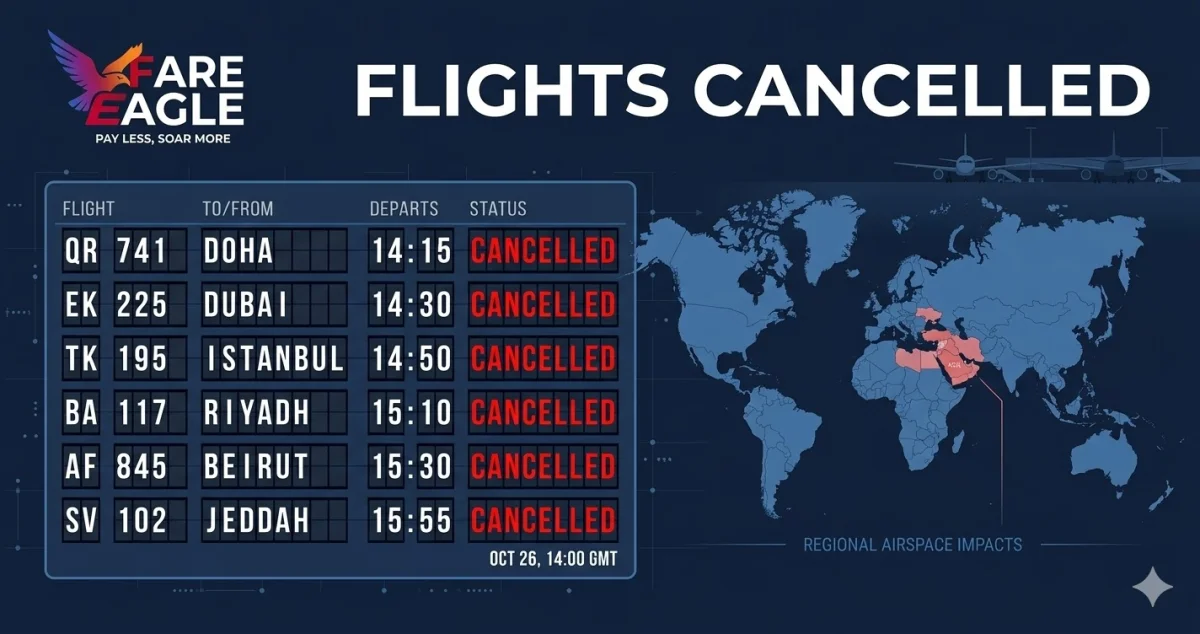
Here's how big this is — it's the worst aviation disruption in the region since COVID:
- Over 29,000 flights cancelled across the Middle East since February 28 (Flightradar24)
- 350+ Indian flights cancelled on Day 1 alone (March 1). Mumbai Airport recorded 57 cancellations in a single day.
- Air India has cancelled approximately 2,500 flights in three weeks
- Emirates is operating at roughly 60% of pre-crisis capacity. Etihad at roughly 15%. Qatar Airways sent 9 widebodies to storage in Spain.
- Pakistan's airspace remains closed to Indian carriers until April 24, 2026 — this compounds the rerouting problem for westbound flights.
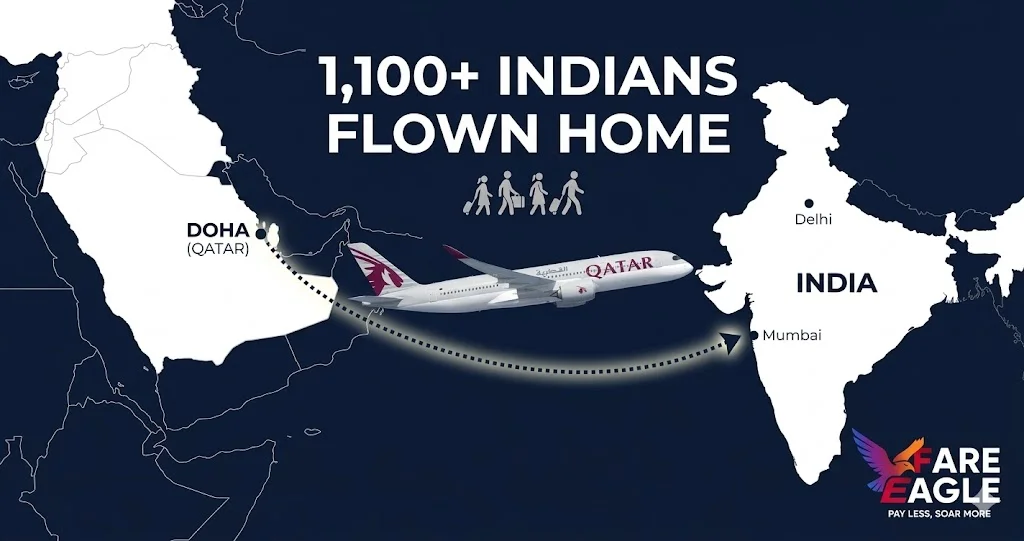
Air India has stepped up rescue operations: 78 additional flights on 9 routes between March 10-18, providing 17,660 extra seats. The airline is running daily rescue/repatriation flights to Dubai, Abu Dhabi, Sharjah, and Ras Al-Khaimah alongside its limited scheduled service to Jeddah and Muscat.
How Fares Have Changed
The capacity crunch has hit fares hard — especially on European routes where flights must reroute around both Middle Eastern and Pakistani airspace, adding 2-4 hours of flight time and significantly higher fuel costs.
| Route | Pre-crisis fare (Feb 28) | Current fare (Mar 19+) | Increase |
|---|---|---|---|
| Delhi → London | ₹35,000–45,000 | ₹85,000–1,20,000 | +100–170% |
| Mumbai → New York | ₹55,000–70,000 | ₹1,30,000–2,25,000 | +136–220% |
| Bengaluru → Frankfurt | ₹40,000–50,000 | ₹1,50,000–1,90,000 | +275–280% |
| Hyderabad → Dubai | ₹12,000–15,000 | ₹40,000–50,000 | +230–330% |
Fare comparison data via Cleartrip, comparing bookings made on Feb 28 vs March 19.
Fuel Surcharges Now Active
Airlines are also passing on rerouting costs through temporary fuel surcharges:
- IndiGo: ₹425–2,300 on domestic routes; $10–200 on international routes
- Air India: ₹399 on domestic tickets
- Air India Express & Akasa Air: Similar surcharges in effect
These surcharges are temporary and will be reviewed as the situation evolves. They apply even on routes not directly affected by the Middle East closure — the fuel cost ripple affects the entire network.
Who Is Affected?
This isn't just about people flying to Dubai or Doha. Millions of Indian travellers use Gulf hubs as transit points to reach destinations like:
- USA & Canada — Dubai and Doha are the most popular connecting hubs for India-USA routes
- Europe — many Indian travellers connect through Abu Dhabi or Doha to reach London, Paris, Frankfurt
- Africa — Emirates and Qatar serve as the primary India-Africa bridge via their hubs
- Australia & New Zealand — Doha and Dubai connections are among the most popular routes from India
- Maldives, Seychelles, Mauritius — holiday destinations often reached via Gulf carriers
If any part of your itinerary touches Dubai (DXB), Abu Dhabi (AUH), or Doha (DOH), you need a contingency plan.
What Should You Do? A Decision Framework
If your flight is in the next 7 days:
- Check if your specific flight is still operating — don't assume it is just because you haven't received a cancellation email
- If the flight is cancelled, the airline must offer you a refund or rerouting
- If the flight is still scheduled but you're uncomfortable, use the travel waiver to change dates or get a refund
- Consider booking a backup ticket on a non-Gulf airline that you can cancel if your original flight operates
If your flight is 1–4 weeks away:
- Don't panic — waivers will almost certainly be extended if disruptions continue
- Start researching alternate routings now so you're not scrambling last minute
- Book a backup on a cancellable fare if a good option exists
- Monitor the situation daily — things are changing fast
If your flight is 1–3 months away:
- Wait and watch — it's too early to make changes, and the situation may resolve
- Do not book new tickets on Gulf carriers for this period unless you're comfortable with the risk of disruption
- If booking new travel, choose airlines that don't route through the Gulf
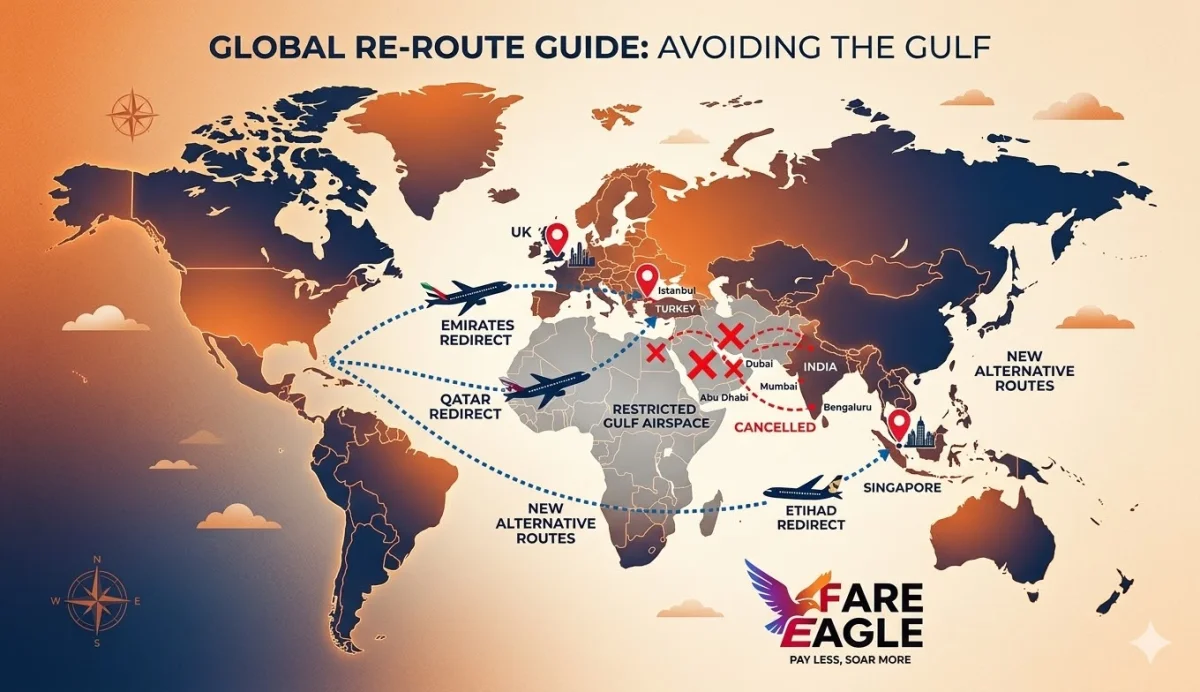
Alternate Routes for Indian Travellers
If you need to avoid Gulf hubs entirely, here are the primary alternatives for common Indian routes:
| Destination | Avoid Gulf — Use These Instead |
|---|---|
| USA (East Coast) | Air India nonstop DEL-JFK/EWR/ORD, or connect via London (BA/Virgin), Frankfurt (Lufthansa), Istanbul (Turkish Airlines) |
| USA (West Coast) | Air India nonstop DEL-SFO, or via Tokyo/Seoul on ANA/JAL/Korean Air, or via Bangkok (Thai Airways) |
| UK & Europe | Air India/BA nonstop DEL/BOM-LHR, Lufthansa via Frankfurt, Turkish via Istanbul, KLM via Amsterdam |
| Australia | Air India DEL-MEL/SYD, Singapore Airlines via SIN, Thai Airways via BKK, Malaysia Airlines via KUL |
| Maldives | IndiGo/Air India nonstop from Indian cities, Sri Lankan Airlines via Colombo |
| Africa | Ethiopian Airlines via Addis Ababa, Kenya Airways via Nairobi, Turkish via Istanbul |
Key takeaway: Istanbul (Turkish Airlines) and Southeast Asian hubs (Singapore, Bangkok, Kuala Lumpur) are the best alternatives to Gulf transit right now. Turkish Airlines in particular has become the go-to rerouting option for many travellers.
Practical Tips
- Always book directly with the airline — if you booked through a third-party travel agent, rebooking and refunds become significantly harder during disruptions. The airline may tell you to contact your agent, and your agent may tell you to contact the airline.
- Keep screenshots of everything — your booking confirmation, the airline's waiver policy page, any cancellation notices. These are your evidence if you need to dispute charges later.
- Don't expect fast customer service — Gulf carriers are dealing with an unprecedented volume of calls and rebooking requests. Hold times will be long. Try the airline's app or website for self-service changes first.
- Travel insurance matters — if you have travel insurance, check if your policy covers "acts of war" or "civil unrest." Many policies exclude these, but some comprehensive plans do cover them.
- If the airline cancels your flight, you're entitled to a full refund — don't accept a voucher unless you actually want one. Under most consumer protection frameworks, a cancelled flight entitles you to a cash refund.
Unaffected Routes — Where You Can Still Fly Normally
Not everything is disrupted. If you need to travel internationally right now and want zero disruption risk:
- Southeast Asia: Bangkok, Bali, Singapore, Vietnam, Malaysia — all routes operating normally with normal fares. See our guide to cheap international trips →
- East Asia: Japan, South Korea, China — no disruption
- Nepal & Sri Lanka: Completely unaffected
- Domestic India: All routes operating normally (fuel surcharges apply but flights are on schedule)
For summer holiday planning that's entirely unaffected, check out our Best Summer Destinations in India 2026 guide — 15 destinations with real budgets and booking tips.
Should You Still Fly Through the Gulf?
This is a personal decision that depends on your risk tolerance. The physical safety risk of transiting through Dubai or Doha is — statistically speaking — still very low. These are highly protected cities with advanced defence systems.
But the disruption risk is high. Even when flights operate, schedules are changing constantly. You could arrive at the airport to find your connecting flight cancelled, leaving you stranded in a transit hub with limited rebooking options and overwhelmed customer service counters.
For essential travel, you can probably still fly through the Gulf. For leisure travel or trips where reliable arrival matters, we'd recommend routing around the region until the situation stabilises.
Search Alternative Routes on FareEagle
FareEagle searches across 100+ airlines simultaneously, so you can easily compare Gulf carrier prices against alternative routings through Istanbul, Singapore, Bangkok, and other hubs. If you need to rebook, search your route on FareEagle to see all available options and fares in one place.
We'll keep this post updated as airline waivers and the situation evolves. Bookmark this page for reference. Last updated: March 26, 2026.