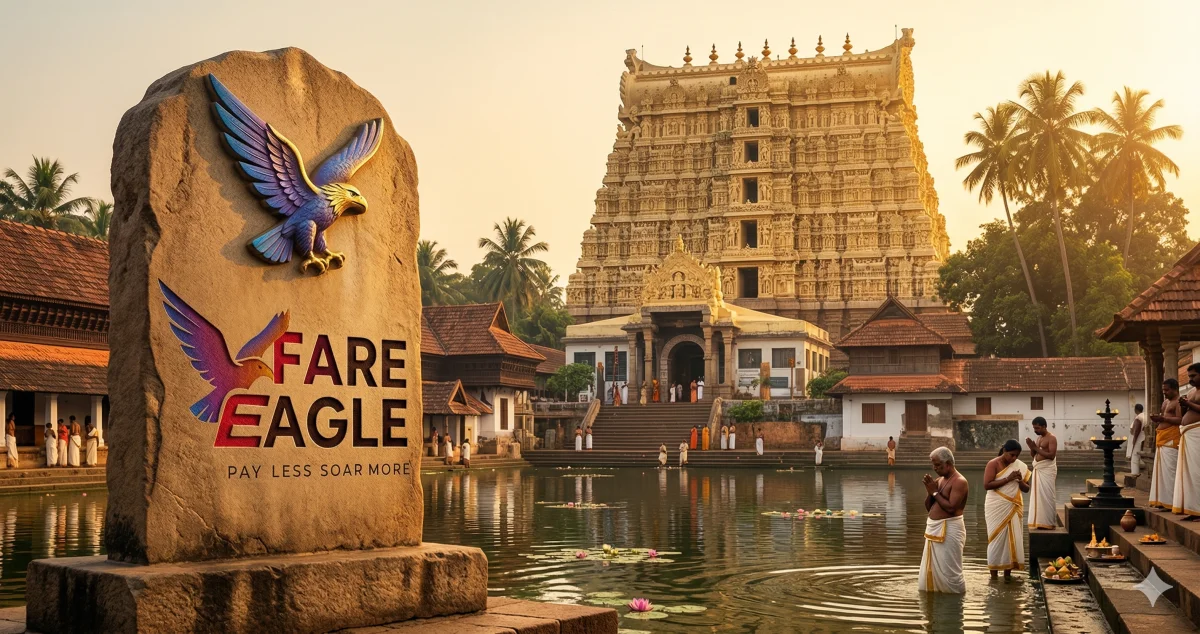
The Sree Padmanabhaswamy Temple in Thiruvananthapuram is the richest temple in the world — its underground vaults hold treasure estimated at over $1 trillion. But devotees don’t come for the gold. They come for the 18-foot idol of Lord Vishnu in the Anantha Shayanam (reclining) pose, crafted from 12,008 sacred Shaligrams brought from the banks of the Gandaki River in Nepal. The deity is so large that you see different parts through three separate doors. The city of Thiruvananthapuram itself is named after this temple — “Thiru Anantha Puram” means “The City of Lord Anantha.” Whether you’re traveling from Bengaluru, flying in from Delhi, or arriving from the Middle East, this guide covers everything for your 2026 visit.
About Sree Padmanabhaswamy Temple
This is one of the 108 Divya Desams (sacred Vaishnavite shrines) and one of the most ancient temples in India. Devotees believe the temple has existed since the first day of Kali Yuga — over 5,000 years ago. The present structure blends Kerala and Dravidian architectural styles with a magnificent 100-foot, seven-tiered gopuram adorned with intricate carvings.
The temple has deep ties to the Travancore Royal Family. In 1750, Maharaja Marthanda Varma dedicated the entire kingdom of Travancore to Lord Padmanabha, declaring himself and all future rulers as “Padmanabha Dasa” (servants of the Lord). The Sree Padmanabhaswamy Temple Trust, overseen by the royal family, manages the temple today.
The sacred water tank Padma Theertham (Lotus Spring) lies adjacent to the temple. Inside the complex, you’ll also find the Thiruvambadi Srikrishna Temple and a Ganesha Temple — most visitors miss these, so make time for all three.
Darshan Timings
The temple follows one of the strictest and most complex darshan schedules of any major Indian temple. Darshan is available only in specific time slots between daily rituals. (Timings may change during festivals.)
Morning slots:
3:15 AM – 4:15 AM — Nirmalya Darshanam (the earliest, most sacred darshan — the deity appears in the previous night’s decoration before the morning rituals begin. Deeply powerful experience for early risers.)
6:30 AM – 7:00 AM — After morning pujas
8:30 AM – 10:00 AM — General darshan (busiest morning slot)
10:30 AM – 11:10 AM — Mid-morning slot
11:45 AM – 12:00 PM — Last morning slot
Temple closed: ~12:00 PM – 5:00 PM
Evening slots:
5:00 PM – 6:15 PM — Evening darshan
6:45 PM – 7:20 PM — Final darshan of the day
Darshan Types
Free darshan: Available in all slots. Queue time: 30 min–2 hours depending on day and season.
Special/VIP darshan: ₹150 (without prasadam) or ₹180 (with prasadam). Separate faster queue with direct access to the sanctum — darshan completed in 15–20 minutes. Book online at the official temple booking portal. Walk-in tickets also available at the counter, but can sell out on busy days.
Couples darshan: ₹250 for two persons, includes pooja thali.
The Strictest Dress Code in India
Padmanabhaswamy Temple enforces the strictest traditional dress code of any major Indian temple. This is non-negotiable — you will be turned away at the gate without exception.
Men: White or off-white dhoti/mundu only, wrapped around the waist reaching the heels. Upper body must be bare or covered only with an angavastram (shawl). No shirts, t-shirts, pants, jeans, or any Western clothing. You can wrap a dhoti over your pants if needed.
Women: Saree, set mundu (mundum neriyathum), or long pavada with blouse only. Salwar kameez/churidar is also permitted. No jeans, skirts, shorts, or Western wear. Girls under 12 may wear gowns.
Dhotis are available for rent (₹20–50) at shops right outside the East Gate. Dress-changing facilities are also available near the entrance. Tip: change at your hotel before coming to avoid the hassle during busy days.
Important: Only Hindus are permitted inside the temple. Foreign nationals of Hindu faith can visit — follow the dress code and carry ID. No mobile phones, cameras, or electronic devices of any kind allowed inside. Deposit everything at the cloakroom near the East Gate. Only loose coins or cash may be carried for offerings.
How to Reach Thiruvananthapuram from Major Indian Cities
By Air
Trivandrum International Airport (TRV) is just 4–6 km from the temple (15–20 minutes by taxi/auto, ₹150–300). It’s an international airport with excellent domestic and international connectivity.
Domestic routes: Bengaluru (1h, multiple daily by IndiGo, Air India), Chennai (1.5h, daily), Delhi (3h, daily by IndiGo, Air India), Mumbai (2h, daily), Hyderabad (1.5h, daily), Kochi (45 min), Kolkata (3h, connecting).
International routes: Dubai, Abu Dhabi, Doha, Muscat, Bahrain, Kuwait, Jeddah, Singapore, Colombo, Male — excellent Gulf connectivity makes this temple very accessible for the large Keralite diaspora in the Middle East.
Compare fares on FareEagle.
By Train
Thiruvananthapuram Central (TVC) is one of the best-connected railway stations in South India, just 1–1.5 km from the temple (auto ₹30–50, walkable). Book on IRCTC.
From Chennai: Trivandrum Express, Ananthapuri Express — 16–18 hours. Daily services.
From Bengaluru: Island Express, Kanyakumari Express — 16–18 hours overnight.
From Delhi: Kerala Express (12625), Rajdhani Express — 36–44 hours. The Kerala Express is one of Indian Railways’ longest-running and most iconic trains.
From Mumbai: Netravati Express, Mumbai–Trivandrum Express — 24–28 hours.
From Kochi/Ernakulam: Frequent trains, 4–5 hours. Multiple daily services. Jan Shatabdi is the fastest.
From Madurai: Direct trains, 5–7 hours. Popular route for devotees combining Tamil Nadu and Kerala temples.
From Kanyakumari: Direct trains, 1.5–2 hours. Easy day trip or combo pilgrimage.
By Road
From Kochi: 220 km via NH66, 4–5 hours. Frequent KSRTC buses and private Volvo services.
From Bengaluru: 730 km, 11–12 hours. Overnight KSRTC Volvo/Sleeper buses available.
From Madurai: 310 km, 5–6 hours via NH744.
From Kanyakumari: 87 km, 1.5–2 hours. Regular buses.
From Kovalam Beach: 16 km, 30 minutes. Many tourists combine Kovalam beach stay with temple visit.
How to Reach from Abroad
From the Middle East (Dubai, Abu Dhabi, Doha, Muscat)
This is the easiest international route. Direct flights from Dubai (Air India Express, IndiGo, ~4h), Abu Dhabi (Etihad, Air India Express, ~4h), Doha (Qatar Airways, ~4.5h), Muscat (Air India Express, ~3.5h), and several Gulf cities. You can land in Trivandrum and be at the temple within 30 minutes of leaving the airport. The large Keralite diaspora in the Gulf makes this one of the busiest international routes to any Indian temple.
From the United States
Best route: Fly to Dubai or Doha, then connect to Trivandrum. Example: New York → Dubai (Emirates, 12h) → Trivandrum (Air India Express, 4h) → taxi to temple (15 min). Alternatively, fly to Bengaluru or Chennai and connect domestically.
From the UK
London → Trivandrum via Dubai or Doha (total 12–14h). Or London → Kochi (connecting) → train to Trivandrum (4.5h).
From Singapore / Malaysia
Direct flights from Singapore to Trivandrum (IndiGo, Scoot, ~4h). Kuala Lumpur connections also available.
The Treasure Vaults
In 2011, the Supreme Court of India ordered an inventory of the temple’s underground vaults. Five of six vaults (A through E) were opened, revealing gold, diamonds, precious stones, golden idols, and jewellery valued at over ₹1 lakh crore (approximately $1 trillion). Vault B remains sealed — it is believed to contain even greater treasure and is protected by ancient locks. The discovery made Padmanabhaswamy officially the wealthiest religious institution in the world.
Festivals
Alpasi Utsavam (October–November) — 10-day festival with grand processions, special pujas, and the temple lit with thousands of lamps.
Painkuni Utsavam (March–April) — 10-day spring festival with elaborate rituals and processions.
Laksha Deepam — Festival of a lakh (100,000) lamps. The entire temple and surroundings are illuminated — one of the most visually stunning temple festivals in India.
Vaikunta Ekadasi — One of the most auspicious days for Vishnu worship. Extremely crowded — arrive early morning.
Accommodation
Budget: Lodges and guest houses near East Fort from ₹500–1,500/night.
Mid-range: Hotels on MG Road and near the railway station, ₹1,500–4,000/night.
Premium: Hotels near Kovalam Beach (16 km) offer luxury beach stays with easy temple access, ₹5,000–15,000/night.
What to Eat
Thiruvananthapuram is a Kerala food paradise. The temple area is strictly vegetarian, but the city offers incredible variety.
Temple prasadam: Available with special darshan tickets. Simple, sacred, and fulfilling.
Kerala sadhya: The traditional vegetarian banana-leaf feast with 20+ dishes. Available at restaurants across the city, especially during Onam season.
Local food: Appam with stew, puttu with kadala curry, dosa, idli, Kerala parotta, filter coffee. Restaurants near East Fort serve excellent meals for ₹80–200.
Banana chips and halwa: Trivandrum’s famous snacks. Buy from shops near Chalai Bazaar.
Places to Visit Near the Temple
Kuthira Malika Palace (Puthen Malika) — Adjacent to the temple. An 18th-century palace with 122 carved wooden horses supporting the roof. Museum with royal artefacts.
Napier Museum & Zoo — 3 km from temple. Indo-Saracenic architecture, natural history museum, and one of India’s oldest zoos.
Kovalam Beach — 16 km. One of India’s most famous beaches. Lighthouse Beach, Hawa Beach, Samudra Beach. Perfect half-day trip.
Kanyakumari — 87 km. The southernmost tip of India. Vivekananda Rock Memorial, Thiruvalluvar Statue. 1.5–2 hour drive.
Varkala Beach — 50 km. Dramatic cliff-top beach with mineral springs. Popular for yoga retreats.
Best Time to Visit
October–February (Winter/Post-monsoon): Best weather (22–32°C). Alpasi Utsavam falls in this period. Peak season for both pilgrims and tourists.
March–May (Summer): Hot and humid (30–35°C). Painkuni Utsavam in March–April. Fewer crowds outside festival days.
June–September (Monsoon): Heavy rain (Kerala monsoon). Temple remains open. Fewest crowds. The lush green surroundings are beautiful, but outdoor sightseeing is limited.
Budget Breakdown
| Expense | Budget | Comfortable |
|---|---|---|
| Temple darshan | Free | ₹150–250 (VIP/couples) |
| Accommodation (1–2 nights) | ₹500–1,500 | ₹2,000–5,000 |
| Food (1–2 days) | ₹200–500 | ₹500–1,000 |
| Local transport | ₹50–200 | ₹300–800 |
Practical Tips
Dress before arriving: The dress code is the strictest in India. Wear your dhoti/saree at the hotel. Changing facilities near the gate exist but are stressful on busy days.
Arrive early: The 3:15 AM Nirmalya Darshanam is the most powerful and least crowded darshan. If you can’t wake that early, the 6:30 AM slot is also relatively quiet.
Book VIP darshan online: Especially important for weekends, festivals, and the Alpasi/Painkuni Utsavam periods. Walk-in VIP tickets sell out quickly.
No electronics: Not even a basic phone. Leave everything at the cloakroom. Carry only coins/cash and your darshan ticket printout.
Combine trips: Trivandrum + Kovalam Beach (16 km) + Kanyakumari (87 km) makes an excellent 3–4 day pilgrimage and leisure circuit. Add Varkala (50 km) for a yoga/beach extension.
Three temples inside: Don’t miss the Thiruvambadi Srikrishna Temple and Ganesha Temple within the same complex — most visitors rush through after the main darshan.
Padma Theertham: The sacred tank next to the temple. Take a moment here before or after darshan.
Frequently Asked Questions
What are Padmanabhaswamy Temple darshan timings?
Morning: 3:15–4:15 AM (Nirmalya), 6:30–7 AM, 8:30–10 AM, 10:30–11:10 AM, 11:45 AM–12 PM. Evening: 5:00–6:15 PM, 6:45–7:20 PM. Temple closed 12 PM–5 PM.
What is the dress code?
Men: dhoti/mundu only (no shirt — bare torso or angavastram). Women: saree, set mundu, or salwar kameez. This is strictly enforced with zero exceptions.
Can non-Hindus visit?
No. Entry is restricted to Hindus only. Foreign nationals of Hindu faith are welcome with proper dress code.
How much does VIP darshan cost?
₹150 without prasadam, ₹180 with prasadam, ₹250 for couples with pooja thali. Book at booking.sreepadmanabhaswamytemple.org.
Is Padmanabhaswamy Temple really the richest in the world?
Yes. The 2011 Supreme Court-ordered inventory of five vaults revealed treasure worth over ₹1 lakh crore ($1 trillion+). Vault B remains unopened.
How do I reach the temple from the airport?
Trivandrum International Airport (TRV) is just 4–6 km from the temple. Taxi: ₹150–300, 15–20 minutes. Auto-rickshaw: ₹100–200. One of the most airport-accessible major temples in India.
How many days do I need?
1 day for temple darshan. 2–3 days if combining with Kovalam Beach, Kuthira Malika Palace, and city sightseeing. 3–4 days if adding Kanyakumari.
Om Namo Narayanaya. Visit the world’s richest temple.
Compare flights to Trivandrum from anywhere in India and abroad on FareEagle.