Every travel blog has a list. Tuesday is the cheapest day to book flights. Book six weeks in advance. Avoid weekend departures. Always pick the LCC. Use incognito mode. Clear your cookies.
I have read these lists for years. So when we built FareEagle, I was curious whether any of this advice actually held up in real fare data. Not anecdotes from a 2017 blog post written about US flights. Real Indian travellers searching real Indian routes.
Between 5 March and 9 May 2026, our database recorded 3,002 flight searches across 1,606 routes, capturing 6,139 individual airline fare records from 128 airlines. Domestic, international, return trips, one-ways. Real searches by real people on our platform.
We pulled the data and ran the numbers. Most of what you have been told about booking cheap flights does not replicate. Here is what we actually found, and what it means for the next time you book.
The honest caveat first
Two months of data is not enough to confidently answer everything. The holy grail question, "does booking 45 days ahead actually beat 14 days?", needs months of tracking the same route at multiple search dates. Most of our route-departure pairs were searched only once or twice in the window. So if a section in this post sounds vague about a number, it is because the data is not strong enough yet to commit to it. We will update this analysis every quarter as data grows.
What our data can answer with confidence: how much airlines vary in price for the exact same trip, who is typically cheapest where, and how much fares move in a single week. That is where this post focuses.
Finding 1: The biggest savings are not about timing. They are about which airline you pick.
This is the single biggest takeaway from the entire study, so I want to put it before everything else.
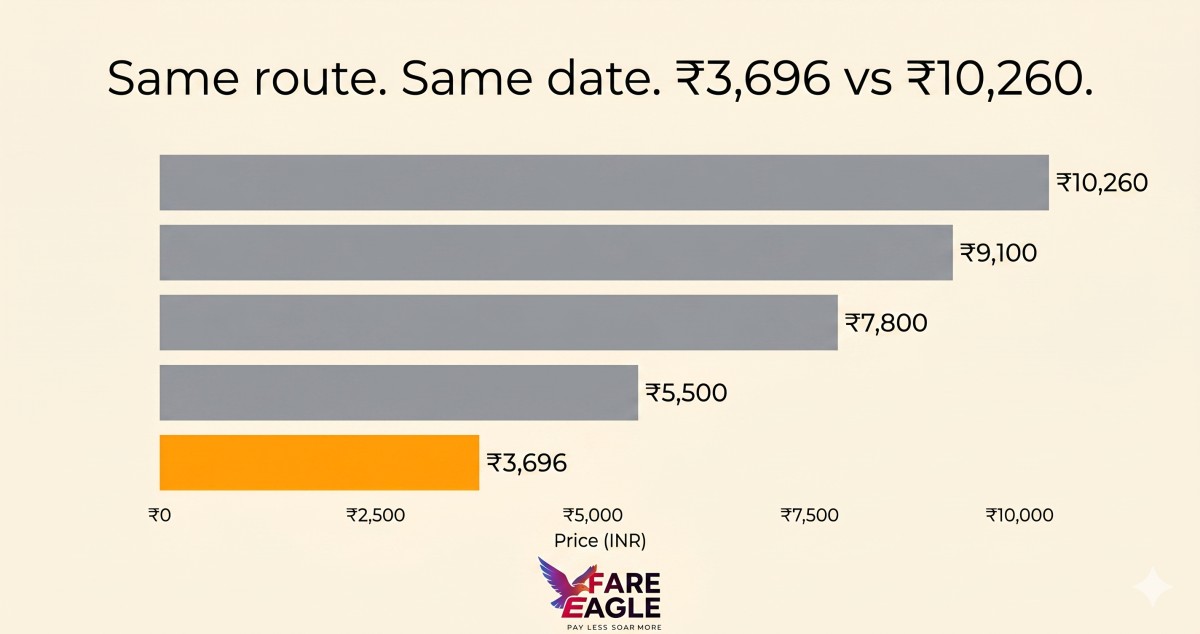
On routes where 3 or more airlines were pricing the same date, the gap between the cheapest and the most expensive airline was, on median, 117%.
That is not a typo. The most expensive airline, on the median route-date, was charging more than double what the cheapest airline charged for the same trip on the same day.
The numbers in plain language:
- 87% of the time, the spread between cheapest and most expensive was over ₹3,000.
- 53% of the time, the most expensive airline charged 2x or more.
- 31% of the time, the most expensive charged 3x or more.
- The average rupee spread was ₹1.26 lakh, pulled up by international routes.
To make this concrete, here is a real Hyderabad to Mumbai search from our data. Same date (1 May 2026), all economy:
- SpiceJet, 1-stop: ₹4,147
- IndiGo, direct: ₹4,204
- Air India, direct: ₹5,712
- IndiGo, 1-stop: ₹6,448
- Air India, 1-stop: ₹8,924
Same route, same day, ₹4,147 to ₹8,924. A 115% gap. If you searched only the airline you happen to have miles with, you potentially paid 2x for a 90-minute flight.
For a Bangalore to London search on the same date in our data, fares ranged from ₹69,646 (Qatar Airways via Doha) to ₹1.83 lakh (Qatar premium fare, same operator). Even within one airline, the fare class and routing decisions create huge spreads.
Practical takeaway: If you are checking only one airline website, you are leaving 30 to 50 percent of your fare on the table. Always compare across airlines for the same route. This single habit is worth more than every "cheapest day to book" hack combined.
Finding 2: IndiGo is cheapest on domestic routes, but only about half the time
The conventional wisdom says: domestic? Just book IndiGo. They will be cheapest.
The data says: yes, mostly. But only about half the time.
Across 395 domestic route-date searches where multiple airlines priced the same trip:
- IndiGo (6E) was cheapest in 51.6% of cases
- Air India (AI) was cheapest in 21.8%
- Air India Express (IX) was cheapest in 17.7%
- SpiceJet (SG) was cheapest in 7.3%
One out of every two domestic searches, IndiGo is not your cheapest option. Almost half the time, you can do better by checking Air India, Air India Express, or SpiceJet first. The savings are sometimes only ₹300-500. Sometimes more like ₹2,000.
This makes more sense after the 2024-25 Air India / Vistara / Air India Express consolidation. The combined Tata aviation group is now competing aggressively on price, and on shorter domestic hops they often beat IndiGo. The mental model from 2018, where IndiGo was always cheapest by ₹2,000, no longer fits 2026.
Finding 3: The "full service costs way more than low cost" story is mostly wrong now
I genuinely expected the data to show a meaningful premium for full-service carriers (Air India, the old Vistara) over LCCs (IndiGo, SpiceJet). The "if you want cheap, suffer the LCC; if you want comfort, pay up" narrative is everywhere.
On 330 domestic route-dates where both an LCC and an FSC priced the same trip:
- Median LCC fare: ₹6,094
- Median FSC fare: ₹6,883
- Median FSC premium: 6.6%
- FSC was actually cheaper than LCC in 37% of cases
A 7% premium for free meals, free seat selection, free check-in baggage, and lounge access at certain airports is, for most travellers, a strong deal. And in 37% of searches, you did not even pay a premium. Air India, Air India Express, or Vistara came in below IndiGo.
The "always book LCC for cheap" advice was true in 2017. It is not true in 2026.
Finding 4: Same flight, same airline. Price moves 10%+ in a single week.
This one is unsettling.
For 168 specific flights (same origin, same destination, same airline, same departure date, same cabin class) observed at multiple search times within a 30-day window:
- The fare changed by more than 10% in 29% of cases.
- The fare changed by more than 20% in 24% of cases.
- The fare changed by more than 50% in 15% of cases.
The most extreme swings in our data came on Delhi to Dubai flights for early-May 2026 departures. On 30 April we saw IndiGo's DEL-DXB at ₹9,258. By 6 May, the same flight was ₹67,479. A 6x jump in seven days. Six different airlines on that route showed 100%+ swings in the same window. This was almost certainly tied to the Gulf airspace situation in early May, which compressed available capacity right before departure.
Even on stable domestic routes, fare drift is real. A Delhi to Chandigarh flight on IndiGo moved from ₹3,950 to ₹10,862 within five days. Same flight, same booking class.
Practical takeaway: if a fare drops below your mental "this is fair" line for a route, book it. The same fare three days later may be 20% higher. We are not saying panic-buy. We are saying that "I will wait and see if it drops" is mathematically risky. The downside of waiting is usually bigger than the upside of catching a small dip.
Finding 5: Who is cheapest on international routes depends entirely on where you're going
The "Gulf carriers are cheapest to Europe" rule is one of the most repeated pieces of Indian travel advice. The data partly supports it, but with surprising twists.
India to Europe (40 route-date pairs, multiple airlines):
- Air India: cheapest in 30%
- IndiGo: cheapest in 25%
- Etihad: cheapest in 18%
- Qatar Airways: cheapest in 12%
Air India's revamped European network is genuinely competitive on price now, especially after the Tata fleet investment. IndiGo's recent international expansion shows up in the data too. The "always go via Dubai or Doha for Europe" advice is no longer the safe default.
India to North America (22 route-date pairs):
- Air India: 27%
- Qatar Airways: 14%
- Virgin Atlantic: 14%
- Etihad and Emirates: 9% each
Air India's nonstop India-US flights (Delhi-New York, Mumbai-Newark, Bengaluru-San Francisco) are often cheaper than the Gulf-routed alternatives, especially when you factor in the cost of one fewer layover and saved hours.
India to Southeast Asia (38 route-date pairs):
- IndiGo: 50%
- Air India: 13%
- Sri Lankan, Vietjet, Malaysia Airlines: rotating in single digits
India to Gulf (34 route-date pairs):
- SpiceJet: 29%
- IndiGo: 24%
- Air India: 24%
- Air India Express: 9%
- Emirates: 9%
The big surprise here: Indian carriers dominate Gulf routes on price. Emirates and Etihad win on product but rarely on raw fare from India. SpiceJet's Dubai operations in particular came in cheapest more often than any single Gulf carrier in our data.
The myths that did not survive our data
Here is the part where popular advice falls apart, with what our data actually shows.
Myth: "Tuesday is the cheapest day to book." Across 2,995 economy searches, normalized to each route's median fare, the median fare index was identical (100% of the route median) on every single day of the week. There is no Tuesday advantage in our data. The original "Tuesday is cheapest" research was about US domestic flights from 2014. It never replicated for Indian carriers, and it does not replicate here.
Myth: "Weekend departures are always pricier." Across all departures, normalised by route, the median weekend premium was zero. The mean had a small weekday lean (Mon, Tue, Wed showed ~5-10% higher mean fares than Saturday) but the median was flat. The premium isn't a universal rule. It's strongly route-and-date specific.
Myth: "Always book direct with the airline for the best price." We are an OTA, so take this with appropriate scepticism, but the data is clear: airlines and their booking systems use different pricing engines and inventory pools. The cheapest fare for a route is just as likely to surface on an aggregator as on the airline's own site. The "always book direct" rule applies to complaints and refunds. There it actually matters. Not to finding the lowest price.
Myth: "Use incognito mode to dodge dynamic pricing." This is hard to test from server-side data, but the technical reality is that airline booking systems price based on demand and time-to-departure, not on whether you are logged in. We have never seen any credible data showing incognito searches return cheaper fares. The effect, if any, is psychological.
What actually works, based on our data
If you take only three things from this post:
- Compare airlines on every search. The 117% median spread between airlines on the same route-date is by far the largest savings lever in flight booking. A 5-minute comparison saves you more than a 5-week wait.
- Don't assume the LCC is cheapest. On Indian domestic routes, IndiGo is cheapest only about half the time. Always check Air India, Air India Express, and SpiceJet too. The 7% median premium for full-service is often a great trade for what you get.
- If a fare looks good, take it. 29% of flights show 10%+ price movement within a week. Waiting to "see if it drops" is mathematically risky on routes where prices typically move up as departure approaches.
How we will keep updating this
This is the first analysis in what we want to make a recurring series. As FareEagle's data grows (more searches, more longitudinal coverage of the same routes), we will be able to answer questions that two months simply cannot. Specifically:
- The actual optimal advance booking window by route distance and seasonality
- Whether fares genuinely dip in specific months (off-peak savings)
- How holiday calendars (Diwali, Christmas, school summer) shift price curves
- Which routes are most volatile and which are most stable
If you are a researcher, journalist, or travel blogger and want anonymised aggregate fare data for your own work, write to [email protected]. The Indian travel industry has a lot of folklore and very little public data behind it. We would like to help change that.
For now: don't trust the Tuesday rule. Don't assume the LCC is cheapest. Compare prices side by side. That is the entire trick.
Search any route, see this for yourself
Every fare we analysed in this post was found through the same engine that powers FareEagle's flight comparison. Try a route you fly often, and you will see exactly the kind of price spreads this post is about.
Methodology note: This analysis is based on FareEagle's internal faresearch log and faretables, capturing user searches between 5 March and 9 May 2026 (3,002 search records and 6,139 airline fare records across 1,606 routes and 128 airlines). We restricted analysis to economy class and excluded multi-passenger searches for fairness. Cheapest-airline percentages reflect route-date pairs where 2+ airlines priced the same trip; spread analysis required 3+ airlines. All currency in INR. Some segments have small sample sizes and we have called those out where they appear.