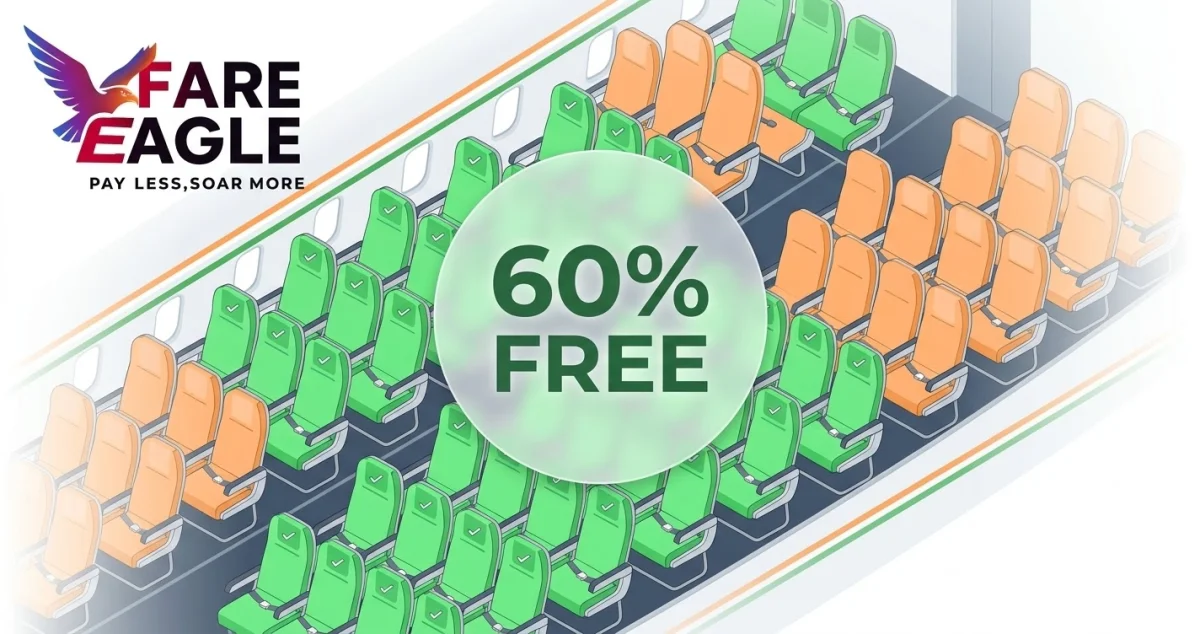
If you've ever booked a domestic flight in India and felt frustrated paying ₹200 to ₹2,100 just to pick a seat, there's good news. The Ministry of Civil Aviation has directed the DGCA to ensure that airlines make at least 60% of seats on every flight available for selection free of charge.
That's triple the current norm. Until now, only about 20% of seats were offered without additional charges. The new directive, announced on 18 March 2026, is part of a broader push by the government to make air travel more passenger-friendly.
What Exactly Changed?
60% free seat selection — Airlines must offer at least 60% of seats on every flight without any additional selection charges. This covers economy seats excluding premium rows and extra-legroom options.
Families seated together — Passengers travelling on the same PNR (booking) must be seated in adjacent seats wherever possible, without extra charges. No more paying a premium just to sit next to your child.
Clear pet and sports equipment policies — Airlines must develop and publish transparent rules for carrying pets, sports gear, and musical instruments.
Passenger rights in regional languages — Airlines must display passenger entitlements prominently on their websites, apps, and airport counters — including in regional languages.
Why Are Airlines Opposed?
The Federation of Indian Airlines (FIA), representing Air India, IndiGo, and SpiceJet — which together hold over 80% of the domestic market — has formally opposed the directive. In a letter to Civil Aviation Secretary Samir Kumar Sinha, FIA raised several concerns.
Their main argument: seat selection fees are a significant revenue stream. Airlines operate on thin margins and depend on ancillary income — fees for seat selection, extra baggage, priority boarding — to offset rising costs like jet fuel, maintenance, and airport charges.
FIA warns that if forced to give up this revenue, airlines will have no choice but to increase base fares. The result? Every passenger pays more — including budget travellers who currently save money by accepting random seat assignment.
Airlines also pointed out that no stakeholder consultation took place before the directive was announced, and questioned whether the government has the legal authority to regulate commercial ancillary pricing in this manner.
Other New Rules Taking Effect
The seat selection mandate is just one part of a broader set of passenger-friendly directives. Other rules being rolled out include:
48-hour cancellation window — Passengers can cancel or amend bookings free of charge within 48 hours, provided the flight is at least 7 days away for domestic and 15 days for international.
Capped cancellation fees — Cancellation charges cannot exceed the base fare plus fuel surcharge. All taxes and other fees must be refunded.
24-hour name correction — Spelling errors in passenger names can be corrected for free within 24 hours of booking.
What Does This Mean for Travellers?
If the rule is implemented as directed, here's what changes for you:
Most economy seats become free to select. You'll be able to pick a window, aisle, or middle seat without paying extra on a majority of seats. Premium rows (front, extra legroom, exit row) will likely still carry charges.
Families won't be separated. If you're booking for a family on a single PNR, the airline must seat you together. This is a massive relief for parents travelling with young children.
Fares might go up. This is the trade-off. If airlines lose ancillary revenue, they may bake that cost into the base fare. Budget carriers that thrive on low base fares plus optional add-ons could be impacted the most.
The Bigger Picture
India is now the third-largest domestic aviation market in the world, handling over 5 lakh passengers daily. With that scale comes the responsibility to balance passenger rights with industry sustainability.
The government has been making several passenger-friendly moves recently — UDAN Yatri Cafés for affordable food at airports, Flybrary for free books, and free airport Wi-Fi. The 60% free seat selection rule is the latest in this series.
Whether it survives airline opposition or gets modified remains to be seen. But the direction is clear: regulators want airlines to stop nickel-and-diming passengers for basic services.
Tips for Booking Smarter Right Now
Regardless of how this policy plays out, here are ways to save on your next flight:
Book early. Seat selection — free or paid — works on a first-come, first-served basis. Book early for the best options.
Use web check-in. Most airlines open web check-in 48 hours before departure. Free seats that open up during this window are often the best value.
Compare across platforms. Prices vary across airlines and booking platforms. A platform like FareEagle lets you compare fares across multiple airlines instantly, so you can find the best deal without the hassle.
Skip paid seats on short flights. On a 1-2 hour domestic hop, does it really matter if you're in row 8 or row 22? Save the ₹500 and spend it at your destination instead.
We'll keep you updated as this story develops. The aviation industry in India is changing fast — and as travellers, that's mostly good news for us.